Scored using Coffee Grinders Methodology v3.0
Coffee Grinders Methodology v3.0
Mathematical & Unbiased Scoring
Products in this category are scored under Frontum Coffee Grinders Methodology v3.0: the technical score from the specifications is the base, and independent expert and video reviews (up to ±0.5 points), owner opinions (up to ±0.3) and best-of lists (up to +0.3) move it up or down.
Explore Coffee Grinders Methodology v3.0

KINGrinder K1 review: 43 specs compared

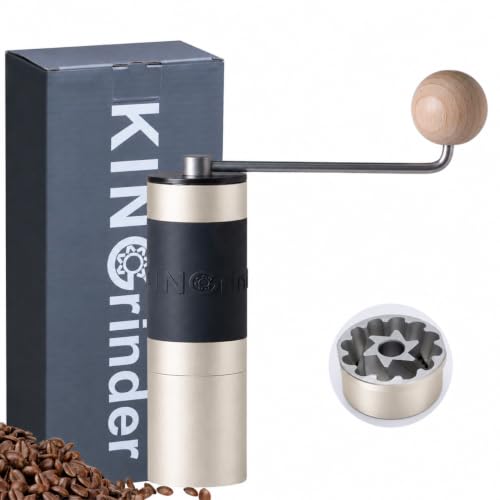
Avg. price:~£55Stepless adjustment:noBean hopper capacity:20 gWeight:0.58 kgDigital display:no

KINGrinder K1 Review: Compare 43 technical specifications to see how this product ranks in the Coffee Grinders category and whether it is worth buying.
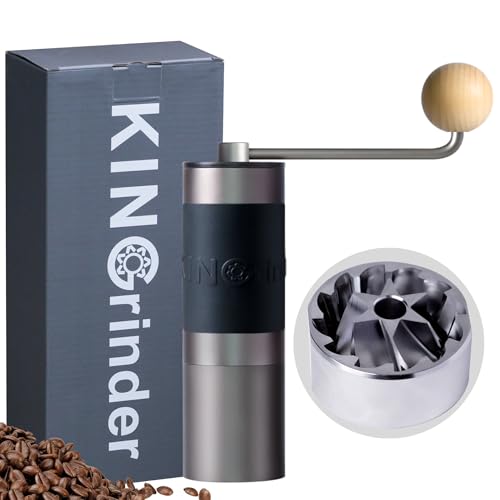
KINGrinder K1
6.7/10

Overall score

Score
6.7/ 10
✕
What it is
Our main score for this model, 1–10. It combines specs, best-of lists, expert reviews, ratings from across the web and owners.
How we count it
Parts: Technical score 55%, List score 20%, Reviews score 10%, User score 10%, Sentiment score 5%
Marks: Each part gets a mark out of 10. For reviews, lists and owners, a typical model in this category gets about 8 and the best one gets 10.
No data yet: A part with no data shows "?". It counts as the mark of a weaker model in this category (4 in 5 models with data score higher). This way, models with reviews, lists and owners usually come out ahead.
Score distribution
▼
<55-66-77-88-99-10
Score components

55%

5.5

Technical score

20%

?

List scoreNot enough data yet, so we use 7.5, the mark of a weaker model in this category

10%

?

Reviews scoreNot enough data yet, so we use 7.9, the mark of a weaker model in this category

10%

9.1

User score

5%

8.9

Sentiment score

▼Worse than 55% of coffee grinders
7.6

Value for money

Value for money
7.6/ 10
✕
What it is
An indicator that combines the coffee grinder's overall rating with its price.
When it matters
When you are looking for a coffee grinder with a good balance between quality and price.
Score distribution
▼
<55-66-77-88-99-10
Score components

70%

6.7

Overall score

30%

9.9

Price

▲Better than 69%
5.5

Technical score

Technical score
5.5/ 10
✕
What it is
How good the specs are compared with the other models in this category, 1–10.
How we count it
Areas: We rate the specs in each area against the other models in this category.
Weighting: The areas that matter most to buyers count more. The shares are shown under Score components.
Share: The technical score is 55% of the overall score.
Score distribution
▼
<55-66-77-88-99-10
Score components

50%

4.2

Grinding

15%

7.8

Design

15%

5.8

Dosing

10%

?

Motor

5%

4.0

Safety

5%

7.3

Maintenance

▼Worse than 67%
?

Reviews score

Reviews score
✕
What it is
Average grade from independent test sites, magazines and video reviewers, 1–10.
How we count it
Grades: Each review's own score is converted to 1–10; without one, we grade the review ourselves. Big test sites count more, short reviews half as much as full tests. A video review counts half.
Score: The average grade is 80% of the review mark; the number of reviews is the other 20% (1 review = 5, the typical number in this category = 8, the most-reviewed model = 10).
Enough data: With few reviews, the average grade is pulled toward the typical grade of this category. No reviews yet: 7.9 for now.
Share: Reviews count 10% of the overall score.
Score distribution
▼
<55-66-77-88-99-10
Grades by review (0)
We have not found an independent test of this model yet. Until we do, its review part counts as 7.9.
Ratings from across the web count in the User score, not in this score.
No expert tests yet
9.1

User score

User score
9.1/ 10
✕
What it is
How happy buyers are with this model, based on ratings from across the web.
How we count it
Enough data: A model needs at least 1 rating from across the web. Without one, it counts as 7.8, the mark of a weaker rated model in this category.
Share: User score counts 10% of the overall score.
Score distribution
▼
<55-66-77-88-99-10

70%

9.4

Rating

30%

8.3

Popularity

▲Better than 85%
?

List score

List score
7.5/ 10
✕
What it is
How often independent test sites, magazines and video reviewers put this model in their best-of lists for this category.
How we count it
Points: The model in the most lists of this category gets 10; the others get 8 to 10 in proportion. In no list yet: 7.5. Lists count 20% of the overall score.
Enough data: Every list counts, even a single one. With fewer than 5 best-of lists in the category, this part is left out.
Lists with this model (0)
Not in any best-of list yet, so this part counts as 7.5. Models in a list get 8 to 10.
Not in any best-of list yet
  • kingrinder-k1
  • kingrinder-k1
  • kingrinder-k1
  • kingrinder-k1
  • kingrinder-k1
  • kingrinder-k1
kingrinder-k1
kingrinder-k1
kingrinder-k1
kingrinder-k1
kingrinder-k1
kingrinder-k1
Where to buy
*As an Amazon Associate, we earn from qualifying purchases.
Best rankings
Available: ranking among products currently available (including other versions of this product).All: ranking among all products in the database.
Loading...
Loading category ranking...

Coffee Grinders model ranking

Ranked #92 of 539 models in Coffee Grinders (Overall score)

Technical Specifications of coffee grinder KINGrinder K1

Technical score
Technical score
5.5/ 10
✕
What it is
How good the specs are compared with the other models in this category, 1–10.
How we count it
Areas: We rate the specs in each area against the other models in this category.
Weighting: The areas that matter most to buyers count more. The shares are shown under Score components.
Share: The technical score is 55% of the overall score.
Score distribution
▼
<55-66-77-88-99-10
Score components:

50%

4.2

Grinding

15%

7.8

Design

15%

5.8

Dosing

10%

?

Motor

5%

4.0

Safety

5%

7.3

Maintenance

5.5
Reviews score
7.9
User score
9.1
List score
?
Value for money
Value for money
7.6/ 10
✕
What it is
An indicator that combines the coffee grinder's overall rating with its price.
When it matters
When you are looking for a coffee grinder with a good balance between quality and price.
Score distribution
▼
<55-66-77-88-99-10
Score components:

70%

6.7

Overall score

30%

9.9

Price

7.6
Operation type
manual
Grinding mechanism
conical burr
Burr diameter
38 mm
This coffee grinder has a 38 mm burr diameter, which is smaller than 85.2% of coffee grinders and equal to 12.7% of coffee grinders.
Grinding element material
stainless steel
Number of grind settings
40
This coffee grinder has 40 grind settings, which is more than 58% of coffee grinders and equal to 7.3% of coffee grinders.
Show more
Bean hopper capacity
20 g
This coffee grinder holds 20 g of beans, which is smaller than 94.8% of coffee grinders and equal to 4.2% of coffee grinders.
Grounds container capacity
25 g
This coffee grinder holds 25 g of grounds, which is smaller than 87.9% of coffee grinders and equal to 4.6% of coffee grinders.
Detachable grounds container
yes
This coffee grinder has a detachable grounds container. 41.7% of coffee grinders have one.
Portafilter holder
no
This coffee grinder does not have a portafilter holder. 41% of coffee grinders offer this.
Single dosing
yes
This coffee grinder supports single dosing. 78.4% of coffee grinders offer this.
Show more
Power
N/A
Voltage
N/A
Grinding speed
N/A
Noise level
?
Overheat protection
N/A
Safety lock
N/A
Non-slip base
no
This coffee grinder does not have a non-slip base. 82% of coffee grinders offer this.
Tool-free burr removal
yes
This coffee grinder lets you remove the burrs without tools. 45.2% of coffee grinders offer this.
Dishwasher-safe parts
no
This coffee grinder does not have dishwasher-safe parts. 12.5% of coffee grinders offer this.
Cleaning brush
yes
This coffee grinder includes a cleaning brush. 56% of coffee grinders offer this.
Main color
grey
Vintage design
no
Digital display
no
This coffee grinder does not have a digital display. 31% of coffee grinders offer this.
Body material
aluminium
Transparent hopper
yes
This coffee grinder has a transparent hopper. 25.7% of coffee grinders have one.
Show more

KINGrinder K1 vs the average coffee grinder

246810TotalGrindingDesignDosingMotorSafetyMaintenance
  • Supports single dosing
    This coffee grinder supports single dosing, while the average coffee grinder does not. 21.8% of coffee grinders offer this.
  • Supports tool-free burr removal
    This coffee grinder removes burrs without tools, while the average coffee grinder does not. 55% of coffee grinders support tool-free burr removal.
  • 68.5% lighter
    This coffee grinder is lighter than the average coffee grinder (0.6 kg vs 1.84 kg). The average coffee grinder weighs 1.84 kg.
    0.58 kg vs 1.84 kg
  • Includes cleaning brush
    This coffee grinder includes a cleaning brush, while the average coffee grinder does not. 44.2% of coffee grinders include one.
  • 23.0% higher user score
    User score
    9.1/ 10
    ✕
    What it is
    How happy buyers are with this model, based on ratings from across the web.
    How we count it
    Enough data: A model needs at least 1 rating from across the web. Without one, it counts as 7.8, the mark of a weaker rated model in this category.
    Share: User score counts 10% of the overall score.
    Score distribution
    ▼
    <55-66-77-88-99-10

    70%

    9.4

    Rating

    30%

    8.3

    Popularity

    9.1 vs 7.4
  • 5 more grind settings
    This coffee grinder has more grind settings than the average coffee grinder (40 vs 35). The average coffee grinder has 35 grind settings.
    40 vs 35
  • 11.8 cm shallower
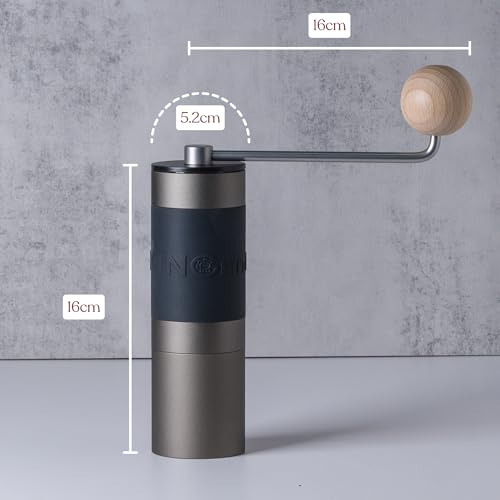
    This coffee grinder is shallower than the average coffee grinder (5.2 cm vs 17 cm). The average coffee grinder is 17 cm deep.
    5.2 cm vs 17 cm
  • 13.6 cm shorter
    This coffee grinder is shorter than the average coffee grinder (16 cm vs 29.6 cm). The average coffee grinder is 29.6 cm tall.
    16 cm vs 29.6 cm
  • 23.0% higher user score
    User score
    9.1/ 10
    ✕
    What it is
    How happy buyers are with this model, based on ratings from across the web.
    How we count it
    Enough data: A model needs at least 1 rating from across the web. Without one, it counts as 7.8, the mark of a weaker rated model in this category.
    Share: User score counts 10% of the overall score.
    Score distribution
    ▼
    <55-66-77-88-99-10

    70%

    9.4

    Rating

    30%

    8.3

    Popularity

    9.1 vs 7.4
  • 18.7% higher sentiment score
    8.9 vs 7.5
  • 5.2% better value for money
    KINGrinder K1 has better value for money than the average coffee grinder (7.63 vs 7.3).
    7.63 vs 7.25
  • 2.73x cheaper
    KINGrinder K1 is cheaper than the average coffee grinder (£55 vs £150).
    £55 vs £150
  • 5 more grind settings
    This coffee grinder has more grind settings than the average coffee grinder (40 vs 35). The average coffee grinder has 35 grind settings.
    40 vs 35
  • 68.5% lighter
    This coffee grinder is lighter than the average coffee grinder (0.6 kg vs 1.84 kg). The average coffee grinder weighs 1.84 kg.
    0.58 kg vs 1.84 kg
  • 11.8 cm shallower
    This coffee grinder is shallower than the average coffee grinder (5.2 cm vs 17 cm). The average coffee grinder is 17 cm deep.
    5.2 cm vs 17 cm
  • 7.8 cm narrower
    This coffee grinder is narrower than the average coffee grinder (5.2 cm vs 13 cm). The average coffee grinder is 13 cm wide.
    5.2 cm vs 13 cm
  • 13.6 cm shorter
    This coffee grinder is shorter than the average coffee grinder (16 cm vs 29.6 cm). The average coffee grinder is 29.6 cm tall.
    16 cm vs 29.6 cm
  • 94% smaller
    This coffee grinder has a smaller volume than the average coffee grinder (432.6 cm³ vs 7,168.03 cm³). The average coffee grinder has a volume of 7,168.03 cm³.
    432.64 cm³ vs 7,168.03 cm³
  • Supports single dosing
    This coffee grinder supports single dosing, while the average coffee grinder does not. 21.8% of coffee grinders offer this.
  • Supports tool-free burr removal
    This coffee grinder removes burrs without tools, while the average coffee grinder does not. 55% of coffee grinders support tool-free burr removal.
  • Includes cleaning brush
    This coffee grinder includes a cleaning brush, while the average coffee grinder does not. 44.2% of coffee grinders include one.
  • 25 mm smaller burr diameter
    This coffee grinder has a smaller burr diameter than the average coffee grinder (38 mm vs 63 mm). The average coffee grinder has a 63 mm burr diameter.
    38 mm vs 63 mm
  • 45 g less grounds space
    This coffee grinder holds fewer grounds than the average coffee grinder (25 g vs 70 g). The average coffee grinder holds 70 g of grounds.
    25 g vs 70 g
  • No non-slip base
    This coffee grinder does not have a non-slip base, while the average coffee grinder does. 81.8% of coffee grinders offer this.
  • 100 g smaller capacity
    This coffee grinder holds fewer beans than the average coffee grinder (20 g vs 120 g). The average coffee grinder holds 120 g of beans.
    20 g vs 120 g
  • No anti-static design
    This coffee grinder does not have an anti-static design, while the average coffee grinder does. 54.1% of coffee grinders have an anti-static design.
  • 25 mm smaller burr diameter
    This coffee grinder has a smaller burr diameter than the average coffee grinder (38 mm vs 63 mm). The average coffee grinder has a 63 mm burr diameter.
    38 mm vs 63 mm
  • No anti-static design
    This coffee grinder does not have an anti-static design, while the average coffee grinder does. 54.1% of coffee grinders have an anti-static design.
  • 45 g less grounds space
    This coffee grinder holds fewer grounds than the average coffee grinder (25 g vs 70 g). The average coffee grinder holds 70 g of grounds.
    25 g vs 70 g
  • 100 g smaller capacity
    This coffee grinder holds fewer beans than the average coffee grinder (20 g vs 120 g). The average coffee grinder holds 120 g of beans.
    20 g vs 120 g
  • No non-slip base
    This coffee grinder does not have a non-slip base, while the average coffee grinder does. 81.8% of coffee grinders offer this.

Third-party reviews

What customers like about KINGrinder K1

  • Excellent value for money and highly affordable compared to premium brands.
  • Robust all-metal construction featuring high-quality aluminum alloy and stainless steel burrs.
  • Dual bearing design provides smooth, consistent grind quality.
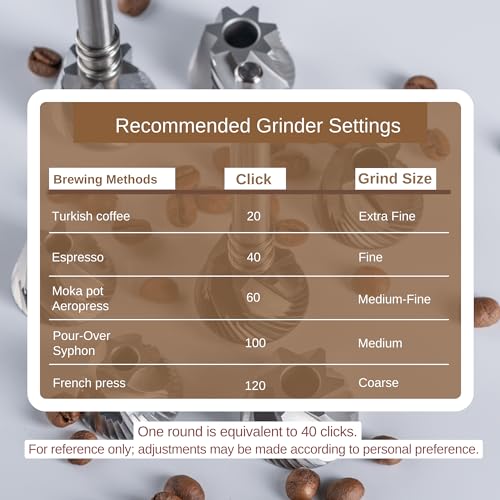
  • Offers a high level of adjustability with 140 settings (40 clicks per rotation).
  • Extremely easy to disassemble by hand and clean with the included brush.
  • Compact and highly portable, making it great for travel and camping.

What customers don't like about KINGrinder K1

  • Internal adjustment mechanism is less convenient to reach and read than external collar designs.
  • Grinding fine enough for espresso takes noticeable physical effort and time due to the smaller 38mm burr size.
  • The straight handle design is less ergonomic and puts more strain on the wrist than offset handle alternatives.
  • Limited hopper and catch cup capacity (20g–25g) makes it inconvenient for brewing multiple cups at once.
  • Produces more fines at finer settings, which caps ultimate particle consistency compared to higher-end models.

Verdict

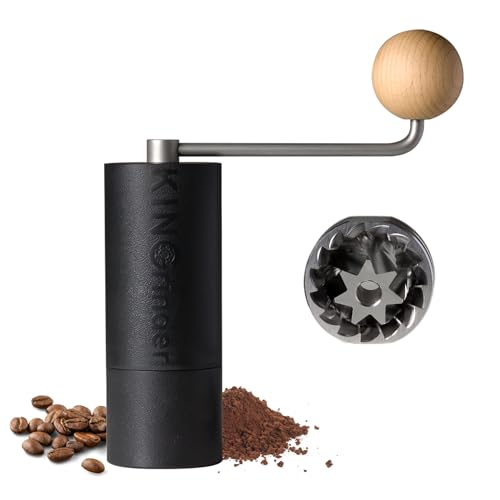
The KINGrinder K1 is a robust manual coffee grinder featuring a durable aluminum alloy body, a dual-bearing shaft design for stability, and 38mm stainless steel conical burrs with a 6-burr hexagonal geometry. It provides a 20g to 25g hopper capacity optimized for single-cup brewing and utilizes an internal multi-stage adjustment mechanism offering 18 microns per click across 40 clicks per rotation. Main pros include high particle uniformity, premium travel-friendly metal construction at a budget-friendly price point, and 1/4-inch hex shank compatibility for electric drill operation. However, its internal dial design is less convenient to access compared to external collars, and its smaller burr size demands significantly more manual cranking time and physical effort when grinding fine enough for espresso.

Compare KINGrinder K1 with other coffee grinders

1Product to compare no. 1
VS
2Product to compare no. 2
VS
3Product to compare no. 3 (optional)

Graphic comparison of KINGrinder K1 and other coffee grinders

No results found