Scored using Coffee Grinders Methodology v3.0
Coffee Grinders Methodology v3.0
Mathematical & Unbiased Scoring
Products in this category are scored under Frontum Coffee Grinders Methodology v3.0: the technical score from the specifications is the base, and independent expert and video reviews (up to ±0.5 points), owner opinions (up to ±0.3) and best-of lists (up to +0.3) move it up or down.
Explore Coffee Grinders Methodology v3.0

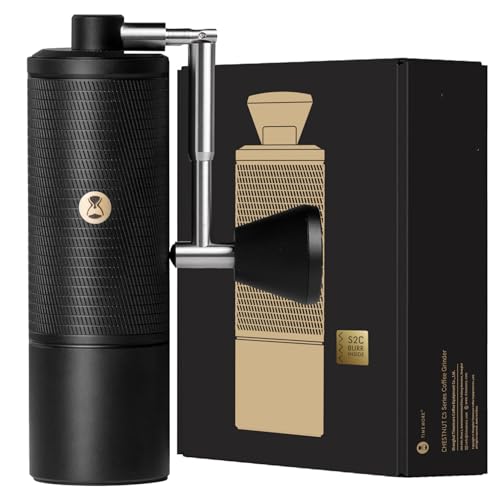
TIMEMORE Chestnut C2S review: 43 specs compared

Avg. price:~£80Stepless adjustment:noBean hopper capacity:25 gWeight:0.7 kgDigital display:no

TIMEMORE Chestnut C2S Review: Compare 43 technical specifications and 2 expert and video reviews to see how this product ranks in the Coffee Grinders category and whether it is worth buying.
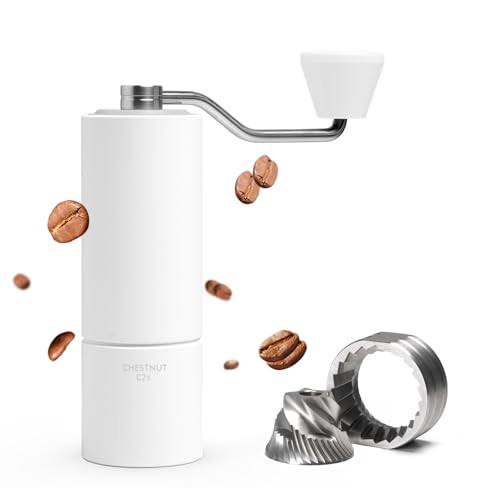
TIMEMORE Chestnut C2S
6.4/10

Overall score

Score
6.4/ 10
✕
What it is
Our main score for this model, 1–10. It combines specs, best-of lists, expert reviews, ratings from across the web and owners.
How we count it
Parts: Technical score 55%, List score 20%, Reviews score 10%, User score 10%, Sentiment score 5%
Marks: Each part gets a mark out of 10. For reviews, lists and owners, a typical model in this category gets about 8 and the best one gets 10.
No data yet: A part with no data shows "?". It counts as the mark of a weaker model in this category (4 in 5 models with data score higher). This way, models with reviews, lists and owners usually come out ahead.
Score distribution
â–¼
<55-66-77-88-99-10
Score components

55%

5.3

Technical score

20%

?

List scoreNot enough data yet, so we use 7.5, the mark of a weaker model in this category

10%

8.2

Reviews score

10%

9.2

User score

5%

?

Sentiment scoreNot enough data yet, so we use 5.3, the mark of a weaker model in this category

â–¼Worse than 62% of coffee grinders
7.4

Value for money

Value for money
7.4/ 10
✕
What it is
An indicator that combines the coffee grinder's overall rating with its price.
When it matters
When you are looking for a coffee grinder with a good balance between quality and price.
Score distribution
â–¼
<55-66-77-88-99-10
Score components

70%

6.4

Overall score

30%

9.8

Price

â–²Better than 56%
5.3

Technical score

Technical score
5.3/ 10
✕
What it is
How good the specs are compared with the other models in this category, 1–10.
How we count it
Areas: We rate the specs in each area against the other models in this category.
Weighting: The areas that matter most to buyers count more. The shares are shown under Score components.
Share: The technical score is 55% of the overall score.
Score distribution
â–¼
<55-66-77-88-99-10
Score components

50%

4.1

Grinding

15%

6.5

Design

15%

5.8

Dosing

10%

?

Motor

5%

6.0

Safety

5%

6.1

Maintenance

â–¼Worse than 70%
8.2

Reviews score

Reviews score
8.2/ 10
✕
What it is
Average grade from independent test sites, magazines and video reviewers, 1–10.
How we count it
Grades: Each review's own score is converted to 1–10; without one, we grade the review ourselves. Big test sites count more, short reviews half as much as full tests. A video review counts half.
Score: The average grade is 80% of the review mark; the number of reviews is the other 20% (1 review = 5, the typical number in this category = 8, the most-reviewed model = 10).
Enough data: With few reviews, the average grade is pulled toward the typical grade of this category. No reviews yet: 7.9 for now.
Share: Reviews count 10% of the overall score.
Score distribution
â–¼
<55-66-77-88-99-10

80%

8.5

Average grade

20%

6.9

Popularity

Grades by review (2)
1 review, with a printed score. 1 video review, counting half as much as a written test. Reviews count 10% of the overall score.
Ratings from across the web count in the User score, not in this score.
â–¼Worse than 52%
9.2

User score

User score
9.2/ 10
✕
What it is
How happy buyers are with this model, based on ratings from across the web.
How we count it
Enough data: A model needs at least 1 rating from across the web. Without one, it counts as 7.8, the mark of a weaker rated model in this category.
Share: User score counts 10% of the overall score.
Score distribution
â–¼
<55-66-77-88-99-10

70%

9.1

Rating

30%

9.3

Popularity

★Better than 91%
?

List score

List score
7.5/ 10
✕
What it is
How often independent test sites, magazines and video reviewers put this model in their best-of lists for this category.
How we count it
Points: The model in the most lists of this category gets 10; the others get 8 to 10 in proportion. In no list yet: 7.5. Lists count 20% of the overall score.
Enough data: Every list counts, even a single one. With fewer than 5 best-of lists in the category, this part is left out.
Lists with this model (0)
Not in any best-of list yet, so this part counts as 7.5. Models in a list get 8 to 10.
Not in any best-of list yet
  • timemore-chestnut-c2s
  • timemore-chestnut-c2s
  • timemore-chestnut-c2s
  • timemore-chestnut-c2s
  • timemore-chestnut-c2s
  • timemore-chestnut-c2s
  • timemore-chestnut-c2s
timemore-chestnut-c2s
Where to buy
    N/A~ £80
Best rankings
Available: ranking among products currently available (including other versions of this product).All: ranking among all products in the database.
Loading...
Loading category ranking...

Technical Specifications of coffee grinder TIMEMORE Chestnut C2S

Technical score
Technical score
5.3/ 10
✕
What it is
How good the specs are compared with the other models in this category, 1–10.
How we count it
Areas: We rate the specs in each area against the other models in this category.
Weighting: The areas that matter most to buyers count more. The shares are shown under Score components.
Share: The technical score is 55% of the overall score.
Score distribution
â–¼
<55-66-77-88-99-10
Score components:

50%

4.1

Grinding

15%

6.5

Design

15%

5.8

Dosing

10%

?

Motor

5%

6.0

Safety

5%

6.1

Maintenance

5.3
Reviews score
8.2
User score
9.2
List score
?
Value for money
Value for money
7.4/ 10
✕
What it is
An indicator that combines the coffee grinder's overall rating with its price.
When it matters
When you are looking for a coffee grinder with a good balance between quality and price.
Score distribution
â–¼
<55-66-77-88-99-10
Score components:

70%

6.4

Overall score

30%

9.8

Price

7.4
Operation type
manual
Grinding mechanism
conical burr
Burr diameter
38 mm
This coffee grinder has a 38 mm burr diameter, which is smaller than 85.2% of coffee grinders and equal to 12.7% of coffee grinders.
Grinding element material
stainless steel
Number of grind settings
36
This coffee grinder has 36 grind settings, which is more than 50.7% of coffee grinders and equal to 4.6% of coffee grinders.
Show more
Bean hopper capacity
25 g
This coffee grinder holds 25 g of beans, which is smaller than 90.8% of coffee grinders and equal to 2.8% of coffee grinders.
Grounds container capacity
25 g
This coffee grinder holds 25 g of grounds, which is smaller than 87.9% of coffee grinders and equal to 4.6% of coffee grinders.
Detachable grounds container
yes
This coffee grinder has a detachable grounds container. 41.7% of coffee grinders have one.
Portafilter holder
no
This coffee grinder does not have a portafilter holder. 41% of coffee grinders offer this.
Single dosing
yes
This coffee grinder supports single dosing. 78.4% of coffee grinders offer this.
Show more
Power
N/A
Voltage
N/A
Grinding speed
N/A
Noise level
?
Overheat protection
no
This coffee grinder does not have overheat protection. 66% of coffee grinders offer this.
Safety lock
N/A
Non-slip base
yes
This coffee grinder has a non-slip base. 18.2% of coffee grinders offer this.
Tool-free burr removal
?
Dishwasher-safe parts
no
This coffee grinder does not have dishwasher-safe parts. 12.5% of coffee grinders offer this.
Cleaning brush
yes
This coffee grinder includes a cleaning brush. 56% of coffee grinders offer this.
Main color
black
Vintage design
no
Digital display
no
This coffee grinder does not have a digital display. 31% of coffee grinders offer this.
Body material
aluminium
Transparent hopper
no
This coffee grinder does not have a transparent hopper. 74.5% of coffee grinders have one.
Show more

TIMEMORE Chestnut C2S vs the average coffee grinder

246810TotalGrindingDesignDosingMotorSafetyMaintenance
  • Supports single dosing
    This coffee grinder supports single dosing, while the average coffee grinder does not. 21.8% of coffee grinders offer this.
  • 62% lighter
    This coffee grinder is lighter than the average coffee grinder (0.7 kg vs 1.84 kg). The average coffee grinder weighs 1.84 kg.
    0.7 kg vs 1.84 kg
  • Includes cleaning brush
    This coffee grinder includes a cleaning brush, while the average coffee grinder does not. 44.2% of coffee grinders include one.
  • 24.3% higher user score
    User score
    9.2/ 10
    ✕
    What it is
    How happy buyers are with this model, based on ratings from across the web.
    How we count it
    Enough data: A model needs at least 1 rating from across the web. Without one, it counts as 7.8, the mark of a weaker rated model in this category.
    Share: User score counts 10% of the overall score.
    Score distribution
    â–¼
    <55-66-77-88-99-10

    70%

    9.1

    Rating

    30%

    9.3

    Popularity

    9.2 vs 7.4
  • 14.9 cm shorter
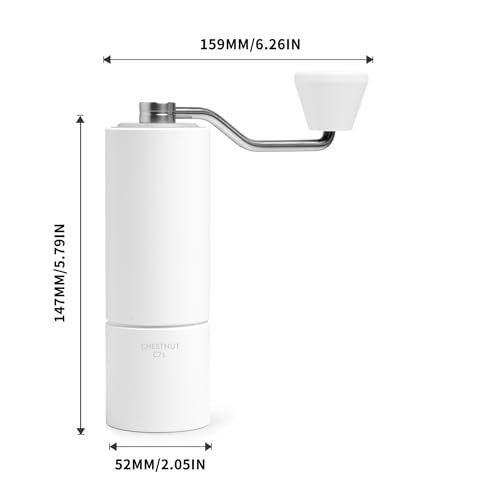
    This coffee grinder is shorter than the average coffee grinder (14.7 cm vs 29.6 cm). The average coffee grinder is 29.6 cm tall.
    14.7 cm vs 29.6 cm
  • 94.5% smaller
    This coffee grinder has a smaller volume than the average coffee grinder (397.5 cm³ vs 7,168.03 cm³). The average coffee grinder has a volume of 7,168.03 cm³.
    397.5 cm³ vs 7,168.03 cm³
  • 11.8 cm shallower
    This coffee grinder is shallower than the average coffee grinder (5.2 cm vs 17 cm). The average coffee grinder is 17 cm deep.
    5.2 cm vs 17 cm
  • 7.8 cm narrower
    This coffee grinder is narrower than the average coffee grinder (5.2 cm vs 13 cm). The average coffee grinder is 13 cm wide.
    5.2 cm vs 13 cm
  • 24.3% higher user score
    User score
    9.2/ 10
    ✕
    What it is
    How happy buyers are with this model, based on ratings from across the web.
    How we count it
    Enough data: A model needs at least 1 rating from across the web. Without one, it counts as 7.8, the mark of a weaker rated model in this category.
    Share: User score counts 10% of the overall score.
    Score distribution
    â–¼
    <55-66-77-88-99-10

    70%

    9.1

    Rating

    30%

    9.3

    Popularity

    9.2 vs 7.4
  • 10.8% higher review score
    Reviews score
    8.2/ 10
    ✕
    What it is
    Average grade from independent test sites, magazines and video reviewers, 1–10.
    How we count it
    Grades: Each review's own score is converted to 1–10; without one, we grade the review ourselves. Big test sites count more, short reviews half as much as full tests. A video review counts half.
    Score: The average grade is 80% of the review mark; the number of reviews is the other 20% (1 review = 5, the typical number in this category = 8, the most-reviewed model = 10).
    Enough data: With few reviews, the average grade is pulled toward the typical grade of this category. No reviews yet: 7.9 for now.
    Share: Reviews count 10% of the overall score.
    Score distribution
    â–¼
    <55-66-77-88-99-10

    80%

    8.5

    Average grade

    20%

    6.9

    Popularity

    Grades by review (2)
    1 review, with a printed score. 1 video review, counting half as much as a written test. Reviews count 10% of the overall score.
    Ratings from across the web count in the User score, not in this score.
    8.2 vs 7.4
  • 87.5% cheaper
    TIMEMORE Chestnut C2S is cheaper than the average coffee grinder (£80 vs £150).
    £80 vs £150
  • 2.5% better value for money
    TIMEMORE Chestnut C2S has better value for money than the average coffee grinder (7.43 vs 7.3).
    7.43 vs 7.25
  • 1 more grind settings
    This coffee grinder has more grind settings than the average coffee grinder (36 vs 35). The average coffee grinder has 35 grind settings.
    36 vs 35
  • 62% lighter
    This coffee grinder is lighter than the average coffee grinder (0.7 kg vs 1.84 kg). The average coffee grinder weighs 1.84 kg.
    0.7 kg vs 1.84 kg
  • 11.8 cm shallower
    This coffee grinder is shallower than the average coffee grinder (5.2 cm vs 17 cm). The average coffee grinder is 17 cm deep.
    5.2 cm vs 17 cm
  • 14.9 cm shorter
    This coffee grinder is shorter than the average coffee grinder (14.7 cm vs 29.6 cm). The average coffee grinder is 29.6 cm tall.
    14.7 cm vs 29.6 cm
  • 94.5% smaller
    This coffee grinder has a smaller volume than the average coffee grinder (397.5 cm³ vs 7,168.03 cm³). The average coffee grinder has a volume of 7,168.03 cm³.
    397.5 cm³ vs 7,168.03 cm³
  • 7.8 cm narrower
    This coffee grinder is narrower than the average coffee grinder (5.2 cm vs 13 cm). The average coffee grinder is 13 cm wide.
    5.2 cm vs 13 cm
  • Supports single dosing
    This coffee grinder supports single dosing, while the average coffee grinder does not. 21.8% of coffee grinders offer this.
  • Includes cleaning brush
    This coffee grinder includes a cleaning brush, while the average coffee grinder does not. 44.2% of coffee grinders include one.
  • 25 mm smaller burr diameter
    This coffee grinder has a smaller burr diameter than the average coffee grinder (38 mm vs 63 mm). The average coffee grinder has a 63 mm burr diameter.
    38 mm vs 63 mm
  • No transparent hopper
    This coffee grinder does not have a transparent hopper, while the average coffee grinder does. 74.3% of coffee grinders have one.
  • No overheat protection
    This coffee grinder does not support overheat protection, while the average coffee grinder does. 65.9% of coffee grinders offer this.
  • 45 g less grounds space
    This coffee grinder holds fewer grounds than the average coffee grinder (25 g vs 70 g). The average coffee grinder holds 70 g of grounds.
    25 g vs 70 g
  • 95 g smaller capacity
    This coffee grinder holds fewer beans than the average coffee grinder (25 g vs 120 g). The average coffee grinder holds 120 g of beans.
    25 g vs 120 g
  • No anti-static design
    This coffee grinder does not have an anti-static design, while the average coffee grinder does. 54.1% of coffee grinders have an anti-static design.
  • 25 mm smaller burr diameter
    This coffee grinder has a smaller burr diameter than the average coffee grinder (38 mm vs 63 mm). The average coffee grinder has a 63 mm burr diameter.
    38 mm vs 63 mm
  • No anti-static design
    This coffee grinder does not have an anti-static design, while the average coffee grinder does. 54.1% of coffee grinders have an anti-static design.
  • No transparent hopper
    This coffee grinder does not have a transparent hopper, while the average coffee grinder does. 74.3% of coffee grinders have one.
  • 45 g less grounds space
    This coffee grinder holds fewer grounds than the average coffee grinder (25 g vs 70 g). The average coffee grinder holds 70 g of grounds.
    25 g vs 70 g
  • 95 g smaller capacity
    This coffee grinder holds fewer beans than the average coffee grinder (25 g vs 120 g). The average coffee grinder holds 120 g of beans.
    25 g vs 120 g
  • No overheat protection
    This coffee grinder does not support overheat protection, while the average coffee grinder does. 65.9% of coffee grinders offer this.

Video reviews

Hands-on testing, unboxing, and real-world video evaluations

9.0
Faith And Coffee Bean
≈ estimated
20/04/2025
Hands-on review · espresso tests with hand grinder
Verdict
TIMEMORE Chestnut C2S is a good hand grinder for espresso, with a solid build and a low price for what it offers.
Hands-on video, no verdict
Not graded

Expert reviews

In-depth analysis and verdict from leading tech publications
8.0
tomsguide.com
✓ explicit
13/03/2026
Lab test · Retention and uniformity
Verdict
The Timemore Chestnut C2S suits upgrades from pre-ground coffee and travel use; it retains almost nothing, but grinds less evenly than the Comandante C40 MK4.

Third-party reviews

What customers like about TIMEMORE Chestnut C2S

  • Excellent value for money as an entry-level manual grinder
  • Highly consistent grind quality for filter, pour-over, and AeroPress brewing
  • Fast and smooth manual grinding action due to dual-bearing stability
  • Upgraded unibody metal construction compared to the original plastic-capped C2
  • Textured aluminum body provides a solid, comfortable, and non-slip grip
  • Compact, lightweight, and highly portable for travel and camping

What customers don't like about TIMEMORE Chestnut C2S

  • Inadequate adjustment precision for fine-tuning espresso extraction
  • Small hopper capacity (around 20-25g) requires grinding in batches for large servings
  • Stepped internal adjustment dial makes it hard to easily track grind changes
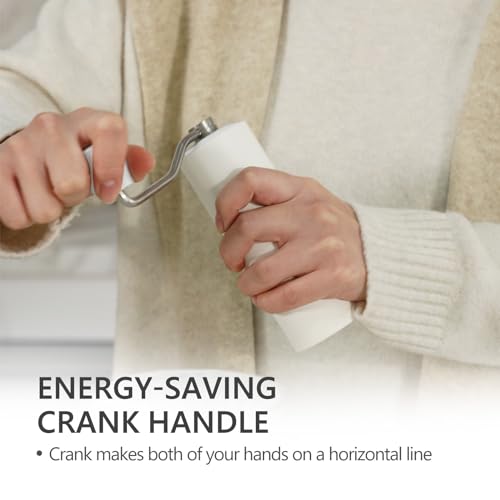
  • Requires manual effort, which can be tiring for lighter roasts or very fine grinds
  • Static buildup can cause minor ground retention inside the catch chamber

Verdict

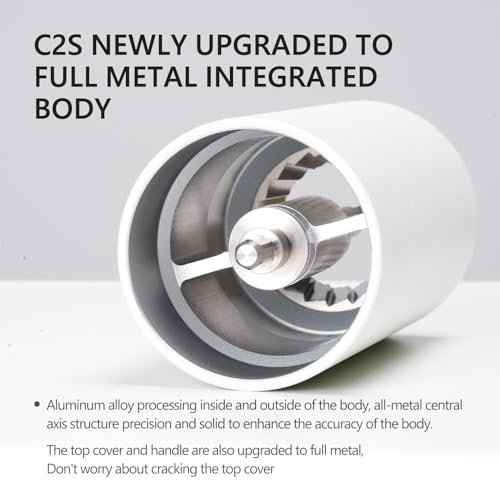
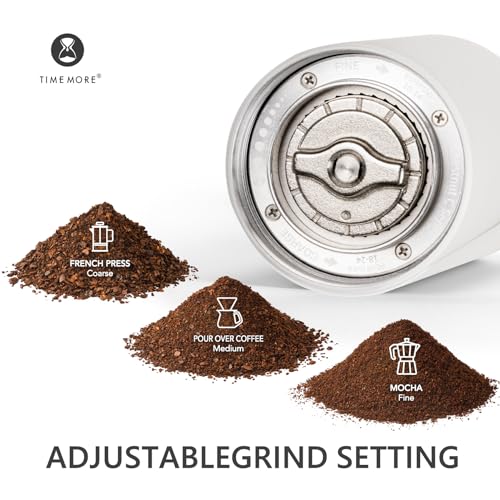
The TIMEMORE Chestnut C2S is an entry-level manual coffee grinder featuring a durable full-metal aluminum alloy unibody, precision CNC-cut 38mm stainless steel conical burrs (55-58HRC hardness), a dual ball-bearing drive shaft, and a stepped internal adjustment wheel offering roughly 36 clicks of coarseness. It is highly praised for its exceptional grind consistency for pour-over and filter methods, high-speed performance grinding up to 1 gram of beans per second, compact 430g lightweight travel-friendly body, and a textured anti-slip grip. However, it requires noticeable manual effort to operate, lacks the micro-adjustments needed for fine espresso dialing-in, and features a relatively small 20-to-25-gram hopper capacity that makes it inefficient for large batch brewing.

Compare TIMEMORE Chestnut C2S with other coffee grinders

1Product to compare no. 1
VS
2Product to compare no. 2
VS
3Product to compare no. 3 (optional)

Graphic comparison of TIMEMORE Chestnut C2S and other coffee grinders

No results found