Scored using Coffee Grinders Methodology v3.0
Coffee Grinders Methodology v3.0
Mathematical & Unbiased Scoring
Products in this category are scored under Frontum Coffee Grinders Methodology v3.0: the technical score from the specifications is the base, and independent expert and video reviews (up to ±0.5 points), owner opinions (up to ±0.3) and best-of lists (up to +0.3) move it up or down.
Explore Coffee Grinders Methodology v3.0

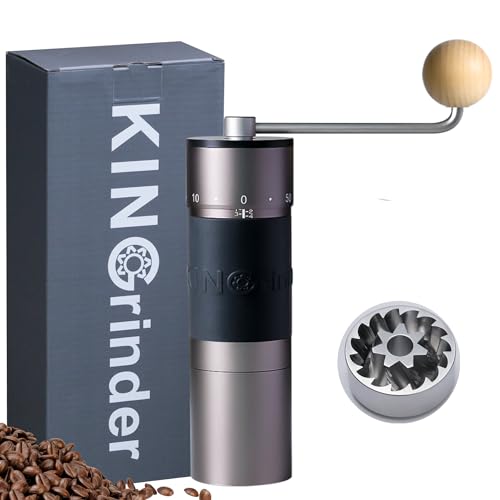
KINGrinder K7 review: 43 specs compared

Avg. price:~£110Stepless adjustment:noBean hopper capacity:35 gWeight:0.65 kgDigital display:no

KINGrinder K7 Review: Compare 43 technical specifications and 8 expert and video reviews to see how this product ranks in the Coffee Grinders category and whether it is worth buying.
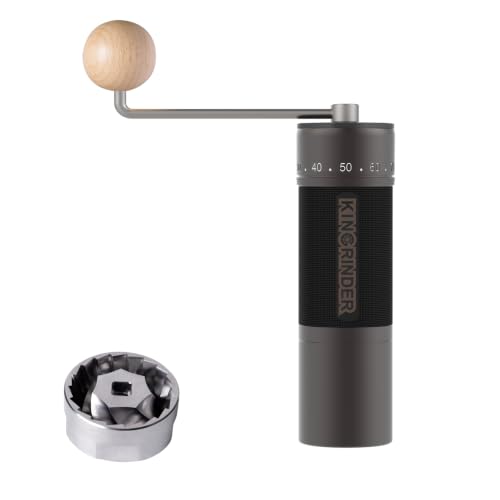
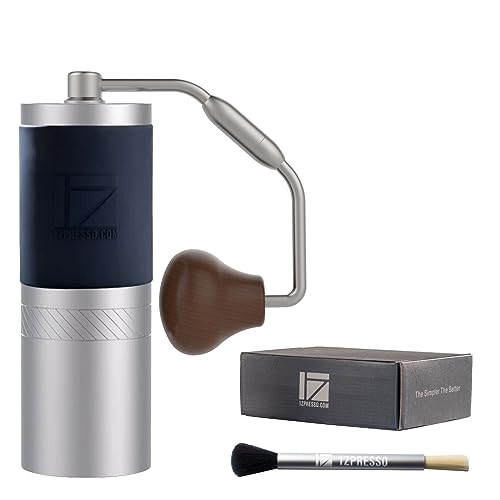
KINGrinder K7
7.1/10

Overall score

Score
7.1/ 10
✕
What it is
Our main score for this model, 1–10. It combines specs, best-of lists, expert reviews, ratings from across the web and owners.
How we count it
Parts: Technical score 55%, List score 20%, Reviews score 10%, User score 10%, Sentiment score 5%
Marks: Each part gets a mark out of 10. For reviews, lists and owners, a typical model in this category gets about 8 and the best one gets 10.
No data yet: A part with no data shows "?". It counts as the mark of a weaker model in this category (4 in 5 models with data score higher). This way, models with reviews, lists and owners usually come out ahead.
Score distribution
â–¼
<55-66-77-88-99-10
Score components

55%

6.9

Technical score

20%

?

List scoreNot enough data yet, so we use 7.5, the mark of a weaker model in this category

10%

8.4

Reviews score

10%

6.9

User score

5%

6.4

Sentiment score

â–²Better than 58% of coffee grinders
7.9

Value for money

Value for money
7.9/ 10
✕
What it is
An indicator that combines the coffee grinder's overall rating with its price.
When it matters
When you are looking for a coffee grinder with a good balance between quality and price.
Score distribution
â–¼
<55-66-77-88-99-10
Score components

70%

7.1

Overall score

30%

9.6

Price

★Better than 91%
6.9

Technical score

Technical score
6.9/ 10
✕
What it is
How good the specs are compared with the other models in this category, 1–10.
How we count it
Areas: We rate the specs in each area against the other models in this category.
Weighting: The areas that matter most to buyers count more. The shares are shown under Score components.
Share: The technical score is 55% of the overall score.
Score distribution
â–¼
<55-66-77-88-99-10
Score components

50%

6.0

Grinding

15%

7.8

Design

15%

5.9

Dosing

10%

10

Motor

5%

10

Safety

5%

7.3

Maintenance

â–²Better than 60%
8.4

Reviews score

Reviews score
8.4/ 10
✕
What it is
Average grade from independent test sites, magazines and video reviewers, 1–10.
How we count it
Grades: Each review's own score is converted to 1–10; without one, we grade the review ourselves. Big test sites count more, short reviews half as much as full tests. A video review counts half.
Score: The average grade is 80% of the review mark; the number of reviews is the other 20% (1 review = 5, the typical number in this category = 8, the most-reviewed model = 10).
Enough data: With few reviews, the average grade is pulled toward the typical grade of this category. No reviews yet: 7.9 for now.
Share: Reviews count 10% of the overall score.
Score distribution
â–¼
<55-66-77-88-99-10

80%

8.3

Average grade

20%

8.9

Popularity

Grades by review (8)
3 reviews: 3 with a printed score, 0 estimated from the review. 5 video reviews, each counting half as much as a written test. Reviews count 10% of the overall score.
Ratings from across the web count in the User score, not in this score.
â–²Better than 61%
6.9

User score

User score
6.9/ 10
✕
What it is
How happy buyers are with this model, based on ratings from across the web.
How we count it
Enough data: A model needs at least 1 rating from across the web. Without one, it counts as 7.8, the mark of a weaker rated model in this category.
Share: User score counts 10% of the overall score.
Score distribution
â–¼
<55-66-77-88-99-10

6.9

Mark 8.0 is below the typical mark 8.4 of this category, so it cannot lift the score above the technical score

70%

8.6

Rating

30%

6.5

Popularity

â–¼Worse than 65%
?

List score

List score
7.5/ 10
✕
What it is
How often independent test sites, magazines and video reviewers put this model in their best-of lists for this category.
How we count it
Points: The model in the most lists of this category gets 10; the others get 8 to 10 in proportion. In no list yet: 7.5. Lists count 20% of the overall score.
Enough data: Every list counts, even a single one. With fewer than 5 best-of lists in the category, this part is left out.
Lists with this model (0)
Not in any best-of list yet, so this part counts as 7.5. Models in a list get 8 to 10.
Not in any best-of list yet
  • kingrinder-k7
  • kingrinder-k7
  • kingrinder-k7
  • kingrinder-k7
  • kingrinder-k7
  • kingrinder-k7
  • kingrinder-k7
kingrinder-k7
kingrinder-k7
kingrinder-k7
kingrinder-k7
kingrinder-k7
kingrinder-k7
kingrinder-k7
Where to buy
*As an Amazon Associate, we earn from qualifying purchases.
Best rankings
Available: ranking among products currently available (including other versions of this product).All: ranking among all products in the database.

What reviewers say about the KINGrinder K7

Based on 4 · 5

Reviewers like the consistent grind, solid build and easy adjustment, but many notice bitterness and weak espresso results.
Praised
Mixed views
Criticised
Pick a topic to see who said what

What owners say about the KINGrinder K7

Based on 17 owners sharing their experience in online comments

29%positive30%mixed41%negative

Owners praise the clean, clear cups, while thin body and unreliable grind settings cause the most frustration.

What owners dislike

  • Some owners find cups thin and light, like water, with little body, even with good beans and careful grind adjustments.4
  • Some owners find cups muted, with little sweetness or flavor depth, and say the grinder does not suit those who want balance and sweetness.4
  • Owners find the grind dial hard to calibrate: the setting seems off, clicks stop around -2 or 110 max, and the dial does not reach the expected range.3

Points mentioned by at least 3 owners, most mentioned first.

Loading...
Loading category ranking...

Coffee Grinders model ranking

Ranked #51 of 539 models in Coffee Grinders (Overall score)

Technical Specifications of coffee grinder KINGrinder K7

Technical score
Technical score
6.9/ 10
✕
What it is
How good the specs are compared with the other models in this category, 1–10.
How we count it
Areas: We rate the specs in each area against the other models in this category.
Weighting: The areas that matter most to buyers count more. The shares are shown under Score components.
Share: The technical score is 55% of the overall score.
Score distribution
â–¼
<55-66-77-88-99-10
Score components:

50%

6.0

Grinding

15%

7.8

Design

15%

5.9

Dosing

10%

10

Motor

5%

10

Safety

5%

7.3

Maintenance

6.9
Reviews score
8.4
User score
6.9
List score
?
Value for money
Value for money
7.9/ 10
✕
What it is
An indicator that combines the coffee grinder's overall rating with its price.
When it matters
When you are looking for a coffee grinder with a good balance between quality and price.
Score distribution
â–¼
<55-66-77-88-99-10
Score components:

70%

7.1

Overall score

30%

9.6

Price

7.9
Operation type
manual
Grinding mechanism
conical burr
Burr diameter
53 mm
This coffee grinder has a 53 mm burr diameter, which is smaller than 62.5% of coffee grinders and equal to 0.3% of coffee grinders.
Grinding element material
stainless steel
Number of grind settings
160
This coffee grinder has 160 grind settings, which is more than 95.4% of coffee grinders.
Show more
What reviewers say
Bean hopper capacity
35 g
This coffee grinder holds 35 g of beans, which is smaller than 83.2% of coffee grinders and equal to 1.5% of coffee grinders.
Grounds container capacity
30 g
This coffee grinder holds 30 g of grounds, which is smaller than 80.1% of coffee grinders and equal to 7.5% of coffee grinders.
Detachable grounds container
yes
This coffee grinder has a detachable grounds container. 41.7% of coffee grinders have one.
Portafilter holder
no
This coffee grinder does not have a portafilter holder. 41% of coffee grinders offer this.
Single dosing
yes
This coffee grinder supports single dosing. 78.4% of coffee grinders offer this.
30-35 g beans, 35 g single-dose capacity
Show more
What reviewers say
Power
N/A
Voltage
N/A
Grinding speed
N/A
Noise level
55.2 dB
This coffee grinder runs at 55.2 dB, which is quieter than 96.8% of coffee grinders.
one of three readings, 54.8 to 55.5 dB(A)
Overheat protection
N/A
Safety lock
N/A
Non-slip base
yes
This coffee grinder has a non-slip base. 18.2% of coffee grinders offer this.
Tool-free burr removal
yes
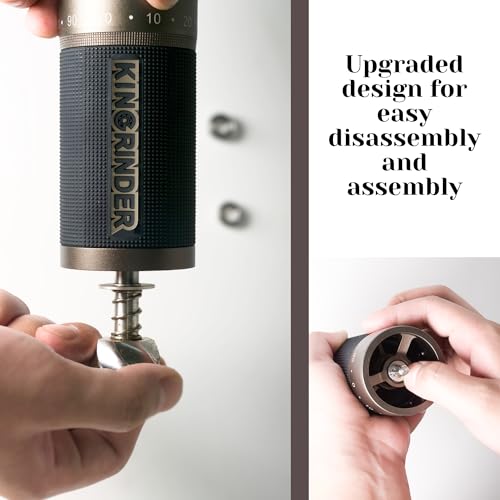
This coffee grinder lets you remove the burrs without tools. 45.2% of coffee grinders offer this.
Dishwasher-safe parts
no
This coffee grinder does not have dishwasher-safe parts. 12.5% of coffee grinders offer this.
Cleaning brush
yes
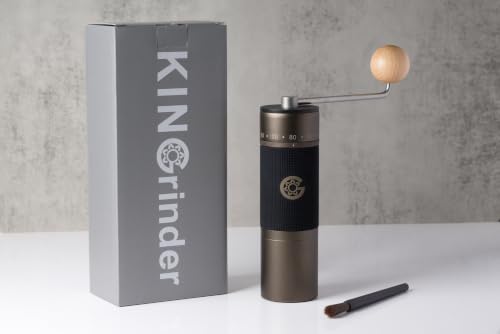
This coffee grinder includes a cleaning brush. 56% of coffee grinders offer this.
Main color
grey
Vintage design
no
Digital display
no
This coffee grinder does not have a digital display. 31% of coffee grinders offer this.
Body material
aluminium
Transparent hopper
yes
This coffee grinder has a transparent hopper. 25.7% of coffee grinders have one.
Show more
What reviewers say

KINGrinder K7 vs the average coffee grinder

246810TotalGrindingDesignDosingMotorSafetyMaintenance
  • 125 more grind settings
    This coffee grinder has more grind settings than the average coffee grinder (160 vs 35). The average coffee grinder has 35 grind settings.
    160 vs 35
  • Supports single dosing
    This coffee grinder supports single dosing, while the average coffee grinder does not. 21.8% of coffee grinders offer this.
    30-35 g beans, 35 g single-dose capacity
  • 19.8 dB quieter
    This coffee grinder is quieter than the average coffee grinder (55.2 dB vs 75 dB). The average coffee grinder runs at 75 dB.
    one of three readings, 54.8 to 55.5 dB(A)
    55.2 dB vs 75 dB
  • Supports tool-free burr removal
    This coffee grinder removes burrs without tools, while the average coffee grinder does not. 55% of coffee grinders support tool-free burr removal.
  • 64.7% lighter
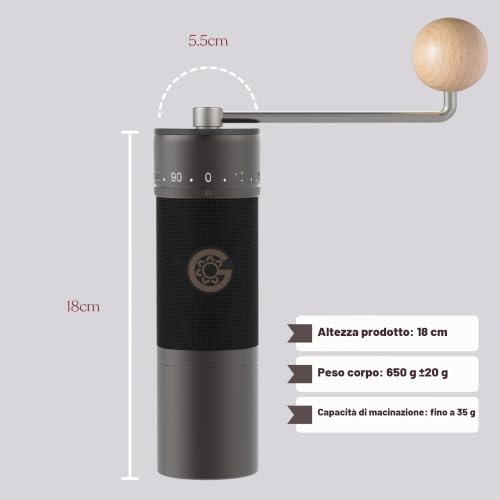
    This coffee grinder is lighter than the average coffee grinder (0.7 kg vs 1.84 kg). The average coffee grinder weighs 1.84 kg.
    0.65 kg vs 1.84 kg
  • Includes cleaning brush
    This coffee grinder includes a cleaning brush, while the average coffee grinder does not. 44.2% of coffee grinders include one.
  • 8.8% better value for money
    KINGrinder K7 has better value for money than the average coffee grinder (7.89 vs 7.3).
    7.89 vs 7.25
  • 11.5 cm shallower
    This coffee grinder is shallower than the average coffee grinder (5.5 cm vs 17 cm). The average coffee grinder is 17 cm deep.
    5.5 cm vs 17 cm
  • 8.8% better value for money
    KINGrinder K7 has better value for money than the average coffee grinder (7.89 vs 7.3).
    7.89 vs 7.25
  • 13.5% higher review score
    Reviews score
    8.4/ 10
    ✕
    What it is
    Average grade from independent test sites, magazines and video reviewers, 1–10.
    How we count it
    Grades: Each review's own score is converted to 1–10; without one, we grade the review ourselves. Big test sites count more, short reviews half as much as full tests. A video review counts half.
    Score: The average grade is 80% of the review mark; the number of reviews is the other 20% (1 review = 5, the typical number in this category = 8, the most-reviewed model = 10).
    Enough data: With few reviews, the average grade is pulled toward the typical grade of this category. No reviews yet: 7.9 for now.
    Share: Reviews count 10% of the overall score.
    Score distribution
    â–¼
    <55-66-77-88-99-10

    80%

    8.3

    Average grade

    20%

    8.9

    Popularity

    Grades by review (8)
    3 reviews: 3 with a printed score, 0 estimated from the review. 5 video reviews, each counting half as much as a written test. Reviews count 10% of the overall score.
    Ratings from across the web count in the User score, not in this score.
    8.4 vs 7.4
  • 36.4% cheaper
    KINGrinder K7 is cheaper than the average coffee grinder (£110 vs £150).
    £110 vs £150
  • 125 more grind settings
    This coffee grinder has more grind settings than the average coffee grinder (160 vs 35). The average coffee grinder has 35 grind settings.
    160 vs 35
  • 64.7% lighter
    This coffee grinder is lighter than the average coffee grinder (0.7 kg vs 1.84 kg). The average coffee grinder weighs 1.84 kg.
    0.65 kg vs 1.84 kg
  • 11.5 cm shallower
    This coffee grinder is shallower than the average coffee grinder (5.5 cm vs 17 cm). The average coffee grinder is 17 cm deep.
    5.5 cm vs 17 cm
  • 7.5 cm narrower
    This coffee grinder is narrower than the average coffee grinder (5.5 cm vs 13 cm). The average coffee grinder is 13 cm wide.
    5.5 cm vs 13 cm
  • 92% smaller
    This coffee grinder has a smaller volume than the average coffee grinder (574.8 cm³ vs 7,168.03 cm³). The average coffee grinder has a volume of 7,168.03 cm³.
    574.8 cm³ vs 7,168.03 cm³
  • 10.6 cm shorter
    This coffee grinder is shorter than the average coffee grinder (19 cm vs 29.6 cm). The average coffee grinder is 29.6 cm tall.
    19 cm vs 29.6 cm
  • Supports single dosing
    This coffee grinder supports single dosing, while the average coffee grinder does not. 21.8% of coffee grinders offer this.
    30-35 g beans, 35 g single-dose capacity
  • 19.8 dB quieter
    This coffee grinder is quieter than the average coffee grinder (55.2 dB vs 75 dB). The average coffee grinder runs at 75 dB.
    one of three readings, 54.8 to 55.5 dB(A)
    55.2 dB vs 75 dB
  • Supports tool-free burr removal
    This coffee grinder removes burrs without tools, while the average coffee grinder does not. 55% of coffee grinders support tool-free burr removal.
  • Includes cleaning brush
    This coffee grinder includes a cleaning brush, while the average coffee grinder does not. 44.2% of coffee grinders include one.
  • 10 mm smaller burr diameter
    This coffee grinder has a smaller burr diameter than the average coffee grinder (53 mm vs 63 mm). The average coffee grinder has a 63 mm burr diameter.
    53 mm vs 63 mm
  • 40 g less grounds space
    This coffee grinder holds fewer grounds than the average coffee grinder (30 g vs 70 g). The average coffee grinder holds 70 g of grounds.
    30 g vs 70 g
  • 85 g smaller capacity
    This coffee grinder holds fewer beans than the average coffee grinder (35 g vs 120 g). The average coffee grinder holds 120 g of beans.
    35 g vs 120 g
  • No anti-static design
    This coffee grinder does not have an anti-static design, while the average coffee grinder does. 54.1% of coffee grinders have an anti-static design.
  • 14.7% lower sentiment score
    6.4 vs 7.5
  • 6.8% lower user score
    User score
    6.9/ 10
    ✕
    What it is
    How happy buyers are with this model, based on ratings from across the web.
    How we count it
    Enough data: A model needs at least 1 rating from across the web. Without one, it counts as 7.8, the mark of a weaker rated model in this category.
    Share: User score counts 10% of the overall score.
    Score distribution
    â–¼
    <55-66-77-88-99-10

    6.9

    Mark 8.0 is below the typical mark 8.4 of this category, so it cannot lift the score above the technical score

    70%

    8.6

    Rating

    30%

    6.5

    Popularity

    6.9 vs 7.4
  • 10 mm smaller burr diameter
    This coffee grinder has a smaller burr diameter than the average coffee grinder (53 mm vs 63 mm). The average coffee grinder has a 63 mm burr diameter.
    53 mm vs 63 mm
  • No anti-static design
    This coffee grinder does not have an anti-static design, while the average coffee grinder does. 54.1% of coffee grinders have an anti-static design.
  • 40 g less grounds space
    This coffee grinder holds fewer grounds than the average coffee grinder (30 g vs 70 g). The average coffee grinder holds 70 g of grounds.
    30 g vs 70 g
  • 85 g smaller capacity
    This coffee grinder holds fewer beans than the average coffee grinder (35 g vs 120 g). The average coffee grinder holds 120 g of beans.
    35 g vs 120 g

Video reviews

Hands-on testing, unboxing, and real-world video evaluations

8.0
My Coffee Show
≈ estimated
12/08/2026
Head-to-head comparison · grind speed, pour-over and espresso tests
Verdict
The KINGrinder K7 is a good first pour-over grinder, though its espresso is only acceptable and the premium rival tastes clearer.
9.0
9 Bar Benchmark
≈ estimated
13/07/2026
Benchmark test · particle size data and espresso and filter tests
Verdict
The KINGrinder K7 is consistent across its whole range with zero retention and is worth its extra cost over the K6.
5.0
Lance Hedrick
≈ estimated
13/02/2026
Three-way comparison · particle distribution and tasting notes
Verdict
The KINGrinder K7 is a fine grinder, but not ZP6 quality, and its cups were the least liked of the three.
9.0
Brew Coffee Home
≈ estimated
24/01/2026
Hands-on comparison · pour-over and espresso tests against K6
Verdict
The KINGrinder K7 is worth trying even if you own the K6; it leans toward pour-over but handles espresso well.
9.0
Hoon's Coffee
≈ estimated
13/09/2026
First look · unboxing, setup and first brew
Verdict
The KINGrinder K7 has a great build and strong value for a budget grinder, but needs proper prep to avoid bitterness.
Not graded

Expert reviews

In-depth analysis and verdict from leading tech publications

7.5
coffeechronicler.com
✓ explicit
06/04/2026
Long-term test · Pour-over and espresso
Verdict
The KINGrinder K7 is a solid pour-over grinder, but its cup quality trails rivals like the Mavo Phantox Pro and it isn't a ZP6 replacement.
8.0
wearethemouth.com
✓ explicit
04/08/2026
Hands-on review · Filter coffee clarity
Verdict
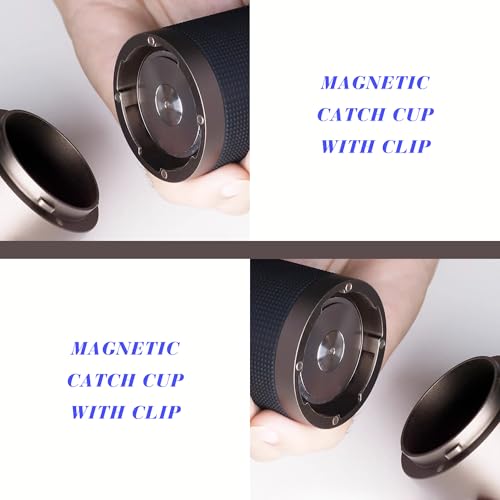
The KINGrinder K7 gives clear, fruity filter cups with its 53mm burrs and easy magnetic catch cup, but its rubber sleeve should come off first.
9.6
9barbenchmark.com
✓ explicit
25/06/2026
Particle size test · Grind consistency
Verdict
The KINGrinder K7 grinds very evenly with almost no retention, but its dial is easy to nudge by accident when you lift the lid.

Third-party reviews

What customers like about KINGrinder K7

  • High flavor clarity and clean flavor separation, especially for light roasts
  • Noticeably highlights bright fruit and sweet acidity in pour-over coffee
  • Excellent particle uniformity with far fewer fines, preventing filter clogging
  • Convenient magnetic twist-lock catch cup that secures firmly and improves workflow
  • True zeroing option and easy-to-use external micro-adjustment dial
  • Larger 53mm 7-edge conical burr set speeds up grinding and makes it effortless
  • Sturdy, premium-feeling all-metal aluminum alloy construction
  • Much easier to fully disassemble and maintain compared to previous models
  • Low retention of coffee grounds when using RDT (water spray technique)

What customers don't like about KINGrinder K7

  • External rubber sleeve can sit too close to the calibration ring, causing calibration drift during heavy use
  • Not optimized for espresso due to a lack of precise micro-adjustments for fine settings
  • The plastic lid/cap feels cheap and fiddly to use
  • Strips away heavy body, producing a thinner or more tea-like mouthfeel that may not suit medium or dark roasts
  • Can leave a slight drying aftertaste if the beans are ground too fine
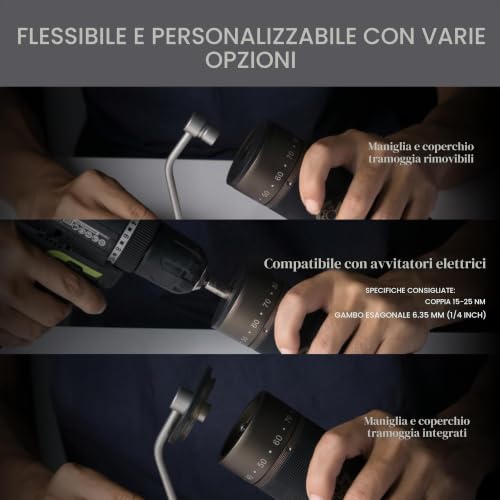
  • Detached handle makes storage slightly more annoying compared to folding alternatives
  • Rubber sleeve can cause discomfort or rubbing on the hand if used multiple times in a row

Verdict

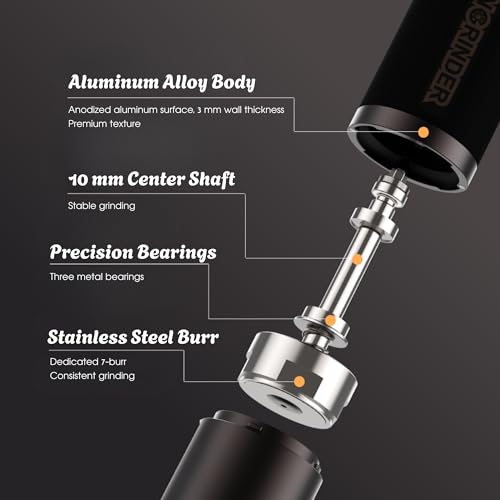
The KINGrinder K7 is a premium manual coffee grinder featuring a massive 53mm 7-edge heptagonal stainless steel conical burr set, a full aluminum alloy body weighing approximately 650 grams, and a hopper capacity of 30 to 35 grams. It is equipped with a 100-click external micro-adjustment top dial that modifies the grind by 15 microns per click, alongside a triple-bearing stabilization system and an innovative dual-locking magnetic and bayonet catch cup. Main pros include exceptional particle uniformity that prevents filter clogging, high-clarity flavor separation ideal for light roast pour-overs, quick grinding speed, and a tool-free disassembly process for effortless maintenance. However, notable cons include a loose exterior rubber sleeve that can accidentally shift the calibration ring, a slightly cheap plastic lid, and average flavor body profile when extracting for espresso.

Compare KINGrinder K7 with other coffee grinders

1Product to compare no. 1
VS
2Product to compare no. 2
VS
3Product to compare no. 3 (optional)

Graphic comparison of KINGrinder K7 and other coffee grinders

No results found