Scored using Projectors Methodology v3.0
Projectors Methodology v3.0
Mathematical & Unbiased Scoring
Products in this category are scored under Frontum Projectors Methodology v3.0: the technical score from the specifications is the base, and independent expert and video reviews (up to ±0.5 points), owner opinions (up to ±0.3) and best-of lists (up to +0.3) move it up or down.
Explore Projectors Methodology v3.0

Zebronics Zeb Pixaplay 54 review: 86 specs compared

Avg. price:~£110Native panel resolution:1280x720ANSI lumens:3800Throw ratio:?Lamp life:50000 hours

Zebronics Zeb Pixaplay 54 Review: Compare 86 technical specifications and 2 expert and video reviews to see how this product ranks in the Projectors category and whether it is worth buying.
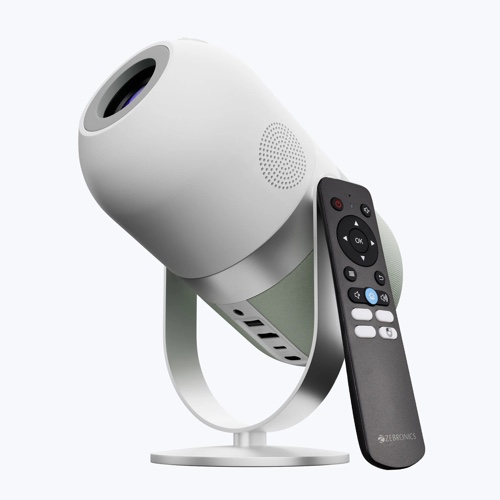
Zebronics Zeb Pixaplay 54
6.6/10

Overall score

Score
6.6/ 10
✕
What it is
Our main score for this model, 1–10. It combines specs, best-of lists, expert reviews and owners.
How we count it
Parts: Technical score 35%, List score 30%, Reviews score 25%, Sentiment score 10%
Marks: Each part gets a mark out of 10. For reviews, lists and owners, a typical model in this category gets about 8 and the best one gets 10.
No data yet: A part with no data shows "?". It counts as the mark of a weaker model in this category (4 in 5 models with data score higher). This way, models with reviews, lists and owners usually come out ahead.
Score distribution
â–¼
<55-66-77-88-99-10
Score components

35%

6.0

Technical score

30%

?

List scoreNot enough data yet, so we use 7.5, the mark of a weaker model in this category

25%

6.0

Reviews score

10%

?

Sentiment scoreNot enough data yet, so we use 6.8, the mark of a weaker model in this category

â–¼Worse than 83% of projectors
7.6

Value for money

Value for money
7.6/ 10
✕
What it is
An indicator that combines the projector's overall rating with its cost.
When it matters
When you are looking for a projector with a good balance between quality and price.
Score distribution
â–¼
<55-66-77-88-99-10
Score components

70%

6.6

Overall score

30%

9.9

Price

â–²Better than 78%
6.0

Technical score

Technical score
6.0/ 10
✕
What it is
How good the specs are compared with the other models in this category, 1–10.
How we count it
Areas: We rate the specs in each area against the other models in this category.
Weighting: The areas that matter most to buyers count more. The shares are shown under Score components.
Share: The technical score is 35% of the overall score.
Score distribution
â–¼
<55-66-77-88-99-10
Score components

42%

6.4

Image Quality

22%

5.6

Projection & Lens

12%

5.5

HDMI & Gaming

10%

6.0

Audio & Features

8%

5.9

Connectivity

6%

6.6

Design & Power

â–¼Worse than 70%
6.0

Reviews score

Reviews score
6.0/ 10
✕
What it is
Average grade from independent test sites, magazines and video reviewers, 1–10.
How we count it
Grades: Each review's own score is converted to 1–10; without one, we grade the review ourselves. Big test sites count more, short reviews half as much as full tests. A video review counts half.
Score: The average grade is 80% of the review mark; the number of reviews is the other 20% (1 review = 5, the typical number in this category = 8, the most-reviewed model = 10).
Enough data: With few reviews, the average grade is pulled toward the typical grade of this category. No reviews yet: 7.8 for now.
Share: Reviews count 25% of the overall score.
Score distribution
â–¼
<55-66-77-88-99-10

6.0

Mark 8.0 is below the typical mark 8.2 of this category, so it cannot lift the score above the technical score

80%

8.4

Average grade

20%

6.1

Popularity

Grades by review (2)
2 video reviews, each counting half as much as a written test. Reviews count 25% of the overall score.
User ratings collected online are not part of this score.
â–¼Worse than 83%
?

List score

List score
7.5/ 10
✕
What it is
How often independent test sites, magazines and video reviewers put this model in their best-of lists for this category.
How we count it
Points: The model in the most lists of this category gets 10; the others get 8 to 10 in proportion. In no list yet: 7.5. Lists count 30% of the overall score.
Enough data: Every list counts, even a single one. With fewer than 5 best-of lists in the category, this part is left out.
Lists with this model (0)
Not in any best-of list yet, so this part counts as 7.5. Models in a list get 8 to 10.
Not in any best-of list yet
  • zebronics-zeb-pixaplay-54
zebronics-zeb-pixaplay-54
Where to buy
    N/A~ £110
Best rankings
Available: ranking among products currently available (including other versions of this product).All: ranking among all products in the database.
Loading...
Loading category ranking...

Technical Specifications of projector Zebronics Zeb Pixaplay 54

Technical score
Technical score
6.0/ 10
✕
What it is
How good the specs are compared with the other models in this category, 1–10.
How we count it
Areas: We rate the specs in each area against the other models in this category.
Weighting: The areas that matter most to buyers count more. The shares are shown under Score components.
Share: The technical score is 35% of the overall score.
Score distribution
â–¼
<55-66-77-88-99-10
Score components:

42%

6.4

Image Quality

22%

5.6

Projection & Lens

12%

5.5

HDMI & Gaming

10%

6.0

Audio & Features

8%

5.9

Connectivity

6%

6.6

Design & Power

6.0
Reviews score
6.0
List score
?
Value for money
Value for money
7.6/ 10
✕
What it is
An indicator that combines the projector's overall rating with its cost.
When it matters
When you are looking for a projector with a good balance between quality and price.
Score distribution
â–¼
<55-66-77-88-99-10
Score components:

70%

6.6

Overall score

30%

9.9

Price

7.6
ANSI lumens
3,800
This projector reaches 3,800 ANSI lumens, brighter than 82.8% of projectors and equal to 0.8% of projectors.
Contrast ratio
1,000:1
This projector has a contrast ratio of 1000:1, lower than 85.9% of projectors and equal to 7.5% of projectors.
Native panel resolution
1280x720
This projector uses a native resolution of 1280x720, lower than 82.1% of projectors and equal to 6.4% of projectors.
Output resolution
1280x720
This projector supports output resolution up to 1280x720, lower than 83.4% of projectors and equal to 5.8% of projectors.
Projection technology
LCD
Show more
Throw ratio
?
Min throw distance
1 m
This projector needs a minimum throw distance of 1 m, shorter than 50.1% of projectors and equal to 10% of projectors.
Max projection size
140 inch
This projector supports projection sizes up to 140 inch, smaller than 77.5% of projectors and equal to 0.7% of projectors.
Zoom ratio
N/A
Motorized zoom
no
This projector does not have motorised zoom. 14.8% of projectors offer this.
Show more
Input lag
?
Auto low latency mode (ALLM)
no
This projector does not switch to low-latency mode automatically. 16.1% of projectors offer this.
Variable refresh rate (VRR)
no
This projector does not support variable refresh rate. 1.8% of projectors offer this.
HDMI version
2
This projector supports HDMI 2, more modern than 46.1% of projectors and equal to 35.9% of projectors.
Max HDMI bandwidth
10.2 Gbps
This projector supports HDMI bandwidth up to 10.2 Gbps, lower than 51.2% of projectors and equal to 46.5% of projectors.
Show more
N. of HDMI ports
1
This projector has 1 HDMI port/s, fewer than 54.2% of projectors and equal to 42.9% of projectors.
Wi-Fi connectivity
yes
This projector connects to Wi-Fi networks for streaming. 46.7% of projectors offer this.
Wi-Fi version
Wi-Fi 5 (802.11ac)
This projector uses Wi-Fi 5 (802.11ac), which is newer than 55.6% of projectors and the same as in 27.5% of projectors.
Bluetooth connectivity
yes
This projector supports Bluetooth for speakers and headphones. 49.4% of projectors offer this.
Bluetooth version
5.1
This projector supports Bluetooth 5.1, more modern than 79.5% of projectors and equal to 7.5% of projectors.
Show more
Smart TV features
yes
This projector has built-in smart TV features. 56.2% of projectors offer this.
Android-based smart OS.
Operating system
Android 9.0
Android OS
yes
This projector runs Android OS. 81% of projectors run Android OS.
Android 9
Dedicated smartphone app
no
This projector does not come with a dedicated smartphone app. 36.8% of projectors come with a dedicated smartphone app.
Remote control
yes
This projector includes a remote control. 1.5% of projectors offer this.
Show more
Light source type
led
This projector uses led light source technology, more advanced than 33.6% of projectors and equal to 39.9% of projectors.
Laser light source
no
This projector does not have a laser light source. 26.8% of projectors offer this.
Lamp life
50,000 hours
This projector offers lamp life of 50,000 hours, shorter than 94.9% of projectors and equal to 2.3% of projectors.
Lamp life (eco mode)
?
Operating power consumption
47.5 W
This projector uses 47.5 W of power, less than 92.6% of projectors.
Show more

Zebronics Zeb Pixaplay 54 vs the average projector

246810TotalImage QualityProjection & LensHDMI & GamingConnectivityAudio & FeaturesDesign & Power
  • 72.7% brighter image
    This projector has higher ANSI lumens than the average projector (3,800 vs 2,200). The average projector has 2,200 ANSI lumens.
    3,800 vs 2,200
  • Supports smart TV apps
    This projector has built-in smart TV features, while the average projector does not. 43.9% of projectors offer smart TV features.
    Android-based smart OS.
  • 30,000 hours longer lamp life
    This projector has a higher lamp life than the average projector (50,000 hours vs 20,000 hours). The average projector has 20,000 hours of lamp life.
    50,000 hours vs 20,000 hours
  • Supports AirPlay
    This projector supports AirPlay, while the average projector does not. 40.3% of projectors offer this.
  • 182.5 W lower power use
    This projector uses less power than the average projector (47.5 W vs 230 W). The average projector uses 230 W of power.
    47.5 W vs 230 W
  • Supports Miracast mirroring
    This projector supports Miracast, while the average projector does not. 46.4% of projectors offer this.
  • Motorized focus
    This projector supports motorized focus, while the average projector does not. 45.6% of projectors support motorized focus.
    Remote-controlled electronic focus.
  • 62.4% lighter weight
    This projector is lighter than the average projector (1.1 kg vs 2.98 kg). The average projector weighs 2.98 kg.
    1.12 kg vs 2.98 kg
  • 6x cheaper
    Zebronics Zeb Pixaplay 54 is cheaper than the average projector (£110 vs £660).
    £110 vs £660
  • 72.7% brighter image
    This projector has higher ANSI lumens than the average projector (3,800 vs 2,200). The average projector has 2,200 ANSI lumens.
    3,800 vs 2,200
  • 3 more recent release
    This projector was released more recently than the average projector (2024 vs 2021). The average projector was released in 2021.
    August 2024
    2024 vs 2021
  • Motorized focus
    This projector supports motorized focus, while the average projector does not. 45.6% of projectors support motorized focus.
    Remote-controlled electronic focus.
  • Supports AirPlay
    This projector supports AirPlay, while the average projector does not. 40.3% of projectors offer this.
  • Supports Miracast mirroring
    This projector supports Miracast, while the average projector does not. 46.4% of projectors offer this.
  • DLNA streaming supported
    This projector supports DLNA streaming, while the average projector does not. 3.2% of projectors support DLNA streaming.
  • Supports smart TV apps
    This projector has built-in smart TV features, while the average projector does not. 43.9% of projectors offer smart TV features.
    Android-based smart OS.
  • Android OS built-in
    This projector features Android OS, while the average projector does not. 19.1% of projectors feature Android OS.
    Android 9
  • 30,000 hours longer lamp life
    This projector has a higher lamp life than the average projector (50,000 hours vs 20,000 hours). The average projector has 20,000 hours of lamp life.
    50,000 hours vs 20,000 hours
  • 182.5 W lower power use
    This projector uses less power than the average projector (47.5 W vs 230 W). The average projector uses 230 W of power.
    47.5 W vs 230 W
  • 62.4% lighter weight
    This projector is lighter than the average projector (1.1 kg vs 2.98 kg). The average projector weighs 2.98 kg.
    1.12 kg vs 2.98 kg
  • 162 mm narrower width
    This projector is narrower than the average projector (135 mm vs 297 mm). The average projector has a width of 297 mm.
    135 mm vs 297 mm
  • 129 mm thinner body
    This projector is thinner than the average projector (21 mm vs 150 mm). The average projector has a thickness of 150 mm.
    21 mm vs 150 mm
  • Limited HDMI format
    This projector supports a less capable max HDMI input format than the average projector (1080p/60Hz vs 4K/120Hz). The average projector supports a max HDMI input format of 4K/120Hz.
    1080p/60Hz vs 4K/120Hz
  • No HDR10 support
    This projector does not support HDR10, while the average projector does. 57.6% of projectors support HDR10.
  • Lower contrast ratio
    This projector has a lower contrast ratio than the average projector (1000:1 vs 10000:1). The average projector has 10000:1 of contrast ratio.
    1,000:1 vs 10,000:1
  • Low native resolution
    This projector has a lower native panel resolution than the average projector (1280x720 vs 1920x1080). The average projector has a native panel resolution of 1920x1080.
    1280x720 vs 1920x1080
  • Lower output resolution
    This projector supports a lower output resolution than the average projector (1280x720 vs 1920x1080). The average projector outputs at 1920x1080 resolution.
    1280x720 vs 1920x1080
  • 1 fewer HDMI ports
    This projector has fewer HDMI ports than the average projector (1 vs 2). The average projector has 2 HDMI ports.
    1 vs 2
  • Basic light source
    This projector has Basic light source than the average projector (led vs laser). The average projector uses a laser light source.
    led vs laser
  • 43.3% lower HDMI bandwidth
    This projector has a lower HDMI bandwidth than the average projector (10.2 Gbps vs 18 Gbps). The average projector has 18 Gbps of HDMI bandwidth.
    10.2 Gbps vs 18 Gbps
  • 18.9% lower review score
    Reviews score
    6.0/ 10
    ✕
    What it is
    Average grade from independent test sites, magazines and video reviewers, 1–10.
    How we count it
    Grades: Each review's own score is converted to 1–10; without one, we grade the review ourselves. Big test sites count more, short reviews half as much as full tests. A video review counts half.
    Score: The average grade is 80% of the review mark; the number of reviews is the other 20% (1 review = 5, the typical number in this category = 8, the most-reviewed model = 10).
    Enough data: With few reviews, the average grade is pulled toward the typical grade of this category. No reviews yet: 7.8 for now.
    Share: Reviews count 25% of the overall score.
    Score distribution
    â–¼
    <55-66-77-88-99-10

    6.0

    Mark 8.0 is below the typical mark 8.2 of this category, so it cannot lift the score above the technical score

    80%

    8.4

    Average grade

    20%

    6.1

    Popularity

    Grades by review (2)
    2 video reviews, each counting half as much as a written test. Reviews count 25% of the overall score.
    User ratings collected online are not part of this score.
    6.0 vs 7.4
  • No HDR10 support
    This projector does not support HDR10, while the average projector does. 57.6% of projectors support HDR10.
  • Lower contrast ratio
    This projector has a lower contrast ratio than the average projector (1000:1 vs 10000:1). The average projector has 10000:1 of contrast ratio.
    1,000:1 vs 10,000:1
  • Low native resolution
    This projector has a lower native panel resolution than the average projector (1280x720 vs 1920x1080). The average projector has a native panel resolution of 1920x1080.
    1280x720 vs 1920x1080
  • Lower output resolution
    This projector supports a lower output resolution than the average projector (1280x720 vs 1920x1080). The average projector outputs at 1920x1080 resolution.
    1280x720 vs 1920x1080
  • 29.4% lower refresh rate
    This projector has a lower refresh rate than the average projector (60 Hz vs 85 Hz). The average projector has 85 Hz of refresh rate.
    60 Hz vs 85 Hz
  • No 3D video
    This projector does not support 3D video, while the average projector does. 55.4% of projectors support 3D video.
  • No 3D glasses support
    This projector does not display 3D with glasses, while the average projector does. 54.4% of projectors offer 3D with glasses.
  • 110 inch smaller image size
    This projector has a lower projection size than the average projector (140 inch vs 250 inch). The average projector has 250 inch of projection size.
    140 inch vs 250 inch
  • Limited HDMI format
    This projector supports a less capable max HDMI input format than the average projector (1080p/60Hz vs 4K/120Hz). The average projector supports a max HDMI input format of 4K/120Hz.
    1080p/60Hz vs 4K/120Hz
  • 43.3% lower HDMI bandwidth
    This projector has a lower HDMI bandwidth than the average projector (10.2 Gbps vs 18 Gbps). The average projector has 18 Gbps of HDMI bandwidth.
    10.2 Gbps vs 18 Gbps
  • 1 fewer HDMI ports
    This projector has fewer HDMI ports than the average projector (1 vs 2). The average projector has 2 HDMI ports.
    1 vs 2
  • No RS-232 control
    This projector does not support RS-232 control, while the average projector does. 50.6% of projectors support RS-232 control.
  • 70% weaker audio output
    This projector has a lower audio output power than the average projector (3 W vs 10 W). The average projector has 10 W of audio output power.
    3 W vs 10 W
  • Basic light source
    This projector has Basic light source than the average projector (led vs laser). The average projector uses a laser light source.
    led vs laser
  • 4 dB louder operation
    This projector has a higher audible noise than the average projector (35 dB vs 31 dB). The average projector has 31 dB of audible noise.
    35 dB vs 31 dB
  • 73 mm taller body
    This projector is taller than the average projector (195 mm vs 122 mm). The average projector has a height of 122 mm.
    195 mm vs 122 mm

Video reviews

Hands-on testing, unboxing, and real-world video evaluations
9.0
SHADAB View
≈ estimated
03/06/2025
Hands-on review · picture, focus and movie tests
Verdict
Zebronics Zeb Pixaplay 54 is a good projector with solid picture quality, and the creator says it is an easy buy.
8.0
Born Creator
≈ estimated
26/08/2024
Hands-on review · picture, focus and sound tests
Verdict
Zebronics Zeb Pixaplay 54 has good picture clarity and nothing obvious is missing, but its small speakers are the main drawback.
Not graded

Third-party reviews

What customers like about Zebronics Zeb Pixaplay 54

  • Excellent value for money for a budget home theater setup
  • Good picture quality and brightness (3800 lumens) in dark rooms
  • Easy setup with automatic vertical keystone correction
  • Effective electronic focus controlled via remote
  • Compact, portable design with a rotating stand for flexible tilting
  • Multiple connectivity options including Dual-band Wi-Fi, Bluetooth 5.1, and Miracast
  • Supports 1080p FHD content playback

What customers don't like about Zebronics Zeb Pixaplay 54

  • Native resolution is actually 720p despite 1080p support claims
  • Weak built-in audio; external speakers are highly recommended
  • Poor visibility in well-lit or bright environments
  • Some apps like Netflix may not work natively or require a separate streaming stick
  • Remote sensor is placed at the back, making it difficult to use if wall-mounted
  • Occasional reports of fan noise and slight blurring at the edges of the screen
  • Android interface can be laggy or run an older, non-updatable version

Verdict

The Zebronics Zeb PixaPlay 54 is a smart LED projector featuring a native HD 720p resolution with support for Full HD 1080p content and a brightness of 3800 lumens. It can project a large screen size up to 356 cm (140 inches) and is powered by a quad-core processor with 1GB RAM and 8GB ROM, running on Android 9.0. Key characteristics include dual-band Wi-Fi (2.4GHz & 5GHz), Bluetooth v5.1, and multiple connectivity options such as HDMI, USB, and AUX OUT. Main pros include its long-lasting 50,000-hour LED lamp life, electronic focus, and vertical auto-keystone correction for easier setup. However, notable cons include its relatively low native resolution (720p), average built-in speaker quality that may require external audio, and limited visibility in well-lit environments due to its 1000:1 contrast ratio.

Compare Zebronics Zeb Pixaplay 54 with other products in the Projectors category

1Product to compare no. 1
VS
2Product to compare no. 2
VS
3Product to compare no. 3 (optional)

Graphic comparison of Zebronics Zeb Pixaplay 54 and other products in the Projectors category

No results found