How much does open-source CRM software cost to deploy and run?
Open-source CRM software costs £0 in direct software licensing fees under open-source licenses, but deploying and running it reliably typically costs about £15-£100 per month in server infrastructure and technical operations. Virtual private servers capable of running modern containerized CRM stacks generally cost £10 to £30 monthly, with high-availability database clusters reaching £70 to £130 per month.
Optional commercial support contracts, vendor-certified security patches, and proprietary marketplace extensions generally range from £15 to £30 per user per month if organizations prefer managed assistance over self-support. Initial deployment consulting and custom development services frequently add £1,700-£8,600 for enterprise installations.
Technical leaders must evaluate total cost of ownership across hardware hosting, automated off-site backups, and sysadmin maintenance hours when comparing open-source platforms against commercial software-as-a-service subscriptions.
What infrastructure and maintenance overhead is required for self-hosting?
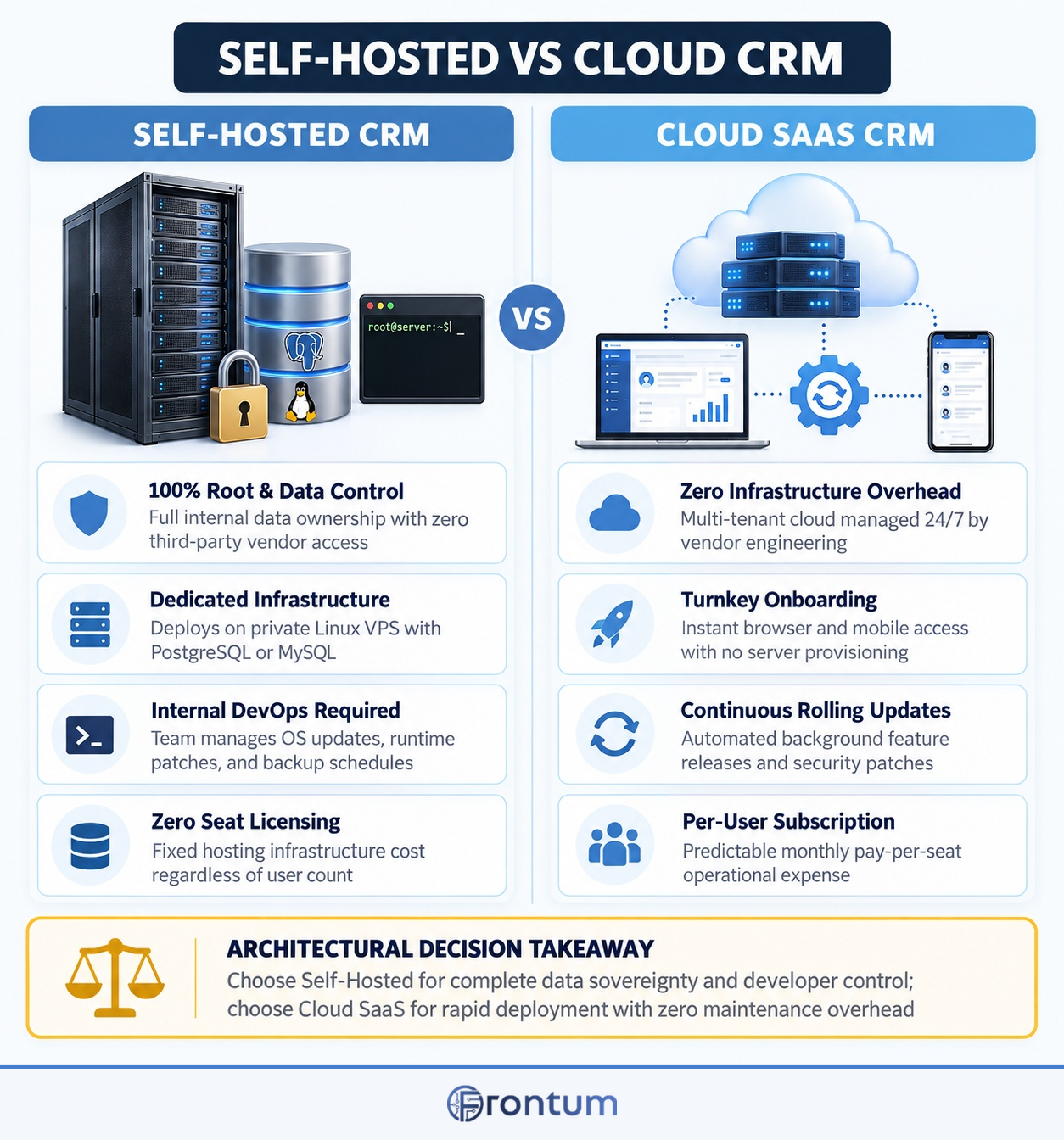
Self-hosting an open-source CRM requires dedicated cloud server infrastructure, database administration expertise, and ongoing systems maintenance to ensure platform availability, data security, and software patch compliance. While open-source software licenses are free, the operational costs of server hosting, backups, and DevOps engineering retainers represent significant ongoing commitments.
Deploying open-source platforms like SuiteCRM or EspoCRM typically requires provisioning a Linux virtual private server running Apache or Nginx, PHP, and MySQL or MariaDB, costing 20 $ to 80 $ monthly on cloud providers like Hetzner, DigitalOcean, or AWS. In addition, systems administrators must configure SSL certificates, automated off-site database backups, failover monitoring, and transactional SMTP email relays like SendGrid or Amazon SES to ensure reliable notification delivery.
Organizations must balance software licensing savings against internal engineering costs. While self-hosting eliminates recurring per-seat SaaS fees, neglecting routine security patching and server maintenance can leave sensitive customer data vulnerable to server intrusions and database corruption.
How do open-source CRMs protect data sovereignty and compliance?
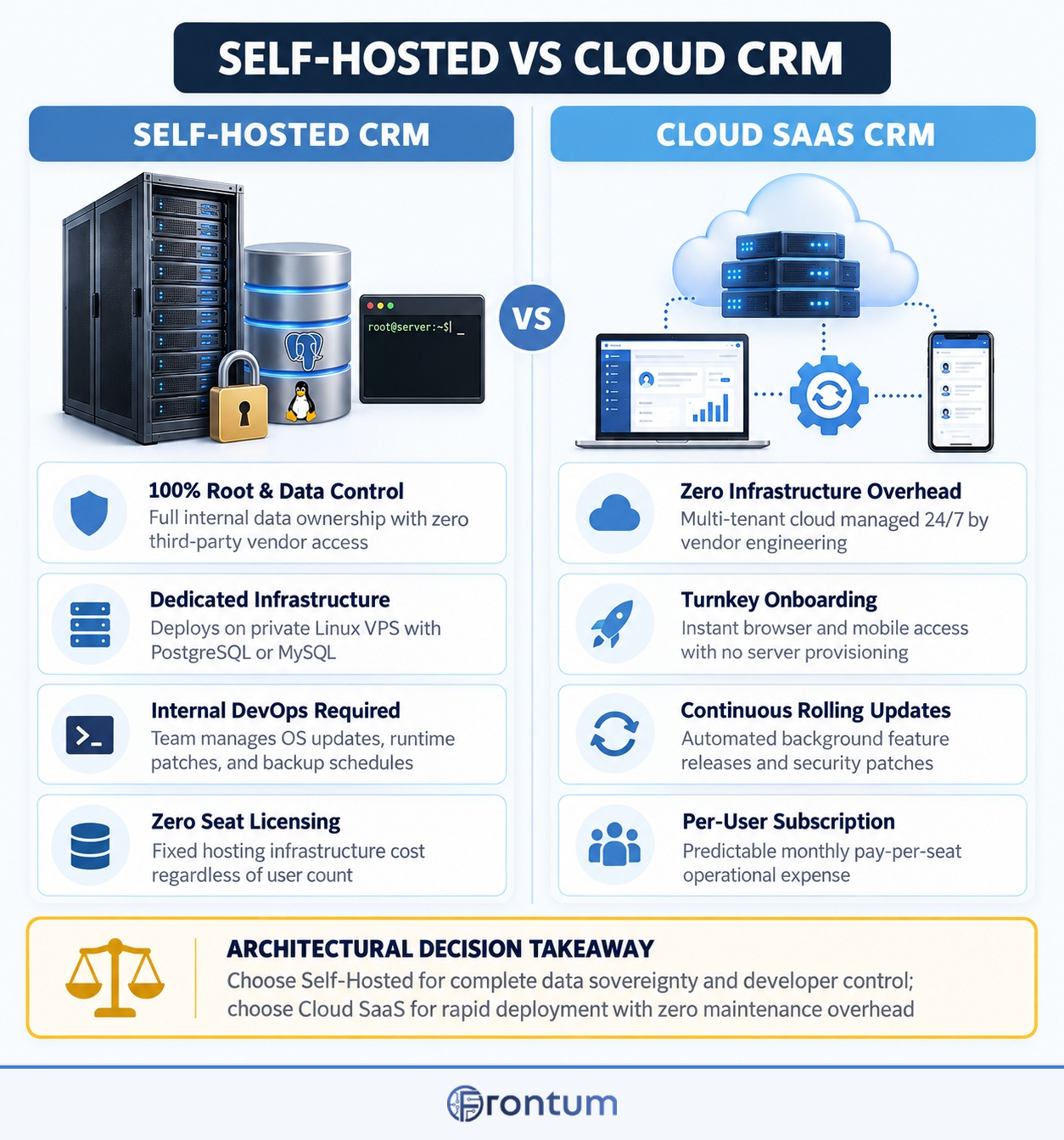
Open-source CRMs protect data sovereignty and compliance by deploying on self-managed infrastructure, guaranteeing that customer records and communication histories remain strictly within defined legal jurisdictions. Retaining root server ownership eliminates foreign surveillance exposure and satisfies strict data localization mandates.
Platforms like SuiteCRM and EspoCRM run on private servers in European data centers, providing complete database isolation and compliance with GDPR and HIPAA. In contrast, commercial platforms such as Salesforce and HubSpot store customer records in proprietary cloud clusters with multi-tenant data routing. Furthermore, open-source codebases allow internal security engineers to audit application logic and verify encryption routines directly.
Maintaining sovereignty requires internal management of security patches, intrusion detection, and off-site backups. Organizations in healthcare, defense, and public sectors frequently find that self-hosted open-source deployments provide the only architecture that satisfies strict statutory residency rules.
What customization and source code flexibility do self-hosted CRMs provide?
Self-hosted and open-source CRMs provide customization capabilities as follows:
- Direct database schema and relational table modification: Full administrative access to the underlying MySQL, MariaDB, or PostgreSQL database architecture, allowing engineering teams to create custom database tables and complex foreign key relationships. Developers extend data schemas without vendor-imposed limitations on field counts or data types.
- Source code auditing and custom module development: Complete access to PHP, Python, or JavaScript application codebases, enabling internal developers to author custom modules, business logic, and UI extensions. Modifying source code allows organizations to tailor system workflows to highly specialized proprietary business processes.
- Unrestricted API access and custom webhook endpoints: Freedom from commercial API rate limits, hourly throttle caps, and paywalled webhooks that restrict high-volume SaaS platforms. Technical teams can build high-frequency data pipelines between the CRM and internal enterprise data warehouses.
- Complete white-labeling and interface customization: Administrative control over software themes, branding assets, custom CSS stylesheets, and navigation menus. Organizations can present a fully branded internal tool to employees or extend white-labeled client portals without vendor watermarks.
- Custom automated backend cron jobs and CLI scripts: Ability to execute scheduled server-side scripts and background command-line utilities directly on the host operating system. Automated cron jobs can perform night-time batch reconciliations, database indexing, and custom data hygiene routines without third-party middleware.
- Full control over infrastructure and server hosting: Flexible choice of hosting environments, from on-premises bare-metal servers to private cloud instances on Hetzner, Scaleway, or AWS. Technical teams optimize server specifications, memory caching, and database clustering to meet exact performance requirements.
- Autonomous data ownership and export flexibility: Unfettered access to raw data backups, database dumps, and document directories without vendor lock-in or export fee penalties. Complete data autonomy ensures companies retain permanent access to historical records regardless of software vendor longevity.
What technical expertise should your team have before adopting an open-source CRM?
Before adopting an open-source CRM, technical teams should confirm the following proficiencies:
- Linux server administration and hosting management: Self-hosting an open-source platform like SuiteCRM or Odoo requires experienced system administrators capable of configuring web servers, PHP runtimes, and Linux environments. Your internal team must manage server provisioning, resource scaling, SSL certificate renewals, and operating system updates independently. Inadequate server optimization can lead to slow query responses and frequent platform crashes during peak sales hours.
- Database maintenance and query optimization: Internal engineers must oversee MySQL or PostgreSQL database tuning, index optimization, and routine storage cleanup to maintain responsive system performance as contact volumes grow. Unoptimized database queries across hundreds of thousands of records can cause interface freezes and pipeline load timeouts for active sales representatives. Teams must possess the technical expertise to diagnose database deadlocks and repair corrupted table indexes without vendor intervention.
- Automated backup and disaster recovery planning: Organizations deploying self-hosted software bear sole responsibility for implementing reliable automated daily snapshots, off-site backup storage, and verified failover protocols. The technical team must regularly test complete system restoration procedures to verify that recovery time objectives can be met in the event of hardware failure or ransomware attack. Relying on untested backup routines leaves company sales data vulnerable to catastrophic, irreversible loss.
- Security patching and vulnerability management: Open-source repositories require continuous monitoring for newly discovered Common Vulnerabilities and Exposures (CVEs) and prompt application of security patches. Delaying security updates exposes customer databases to unauthorized exploitation, data exfiltration, and severe regulatory penalties. Internal engineering resources must be allocated to test patches in isolated staging environments before deploying updates to production systems.
- Custom module development and API integration: Extending platform functionality, building custom workflow triggers, or connecting internal proprietary databases requires proficient developers skilled in languages like PHP, Python, or JavaScript. While proprietary SaaS platforms offer point-and-click automation builders, open-source platforms often require writing bespoke code for complex business logic. The ongoing engineering cost of building and maintaining custom integrations can easily exceed commercial SaaS subscription fees over several years.
- Email server deliverability and SMTP configuration: Self-hosted installations require careful setup of dedicated transactional email services, reverse DNS records, and SPF, DKIM, and DMARC authentication protocols. Misconfigured outbound mail servers can cause important sales communications and meeting invitations to land directly in recipient spam folders. Engineering staff must actively monitor IP reputation and bounce rates across major email providers to protect email deliverability.
- User management and identity access governance: Integrating open-source installations with corporate identity providers via LDAP, Active Directory, or SAML 2.0 requires dedicated directory integration expertise. IT administrators must configure secure role-based permissions, multi-factor authentication, and automated user provisioning to enforce enterprise access policies. Maintaining manual user administration across separate databases increases security risks when employees depart the company.