How much does European CRM software cost?
European CRM software commonly costs about 15–£50 per user per month on standard commercial subscription tiers, with enterprise packages ranging from £60 to £120 per seat monthly. Entry-level plans typically start between £12 and £20 per seat, providing visual pipeline management, GDPR consent tracking, and localized customer records for growing teams.
Mid-tier subscriptions priced from £25 to £50 per seat unlock automated email sequences, multi-currency deal pipelines, regional VAT quotation templates, and advanced role-based permissions. Annual billing commitments routinely offer 15–20% discounts compared to month-to-month invoicing, making annual contracts standard across European businesses.
European companies should also budget for optional enterprise modules such as dedicated sovereign cloud instances, specialized regional ERP connectors, and priority legal compliance support.
How does European data hosting and sovereign cloud infrastructure ensure GDPR compliance?
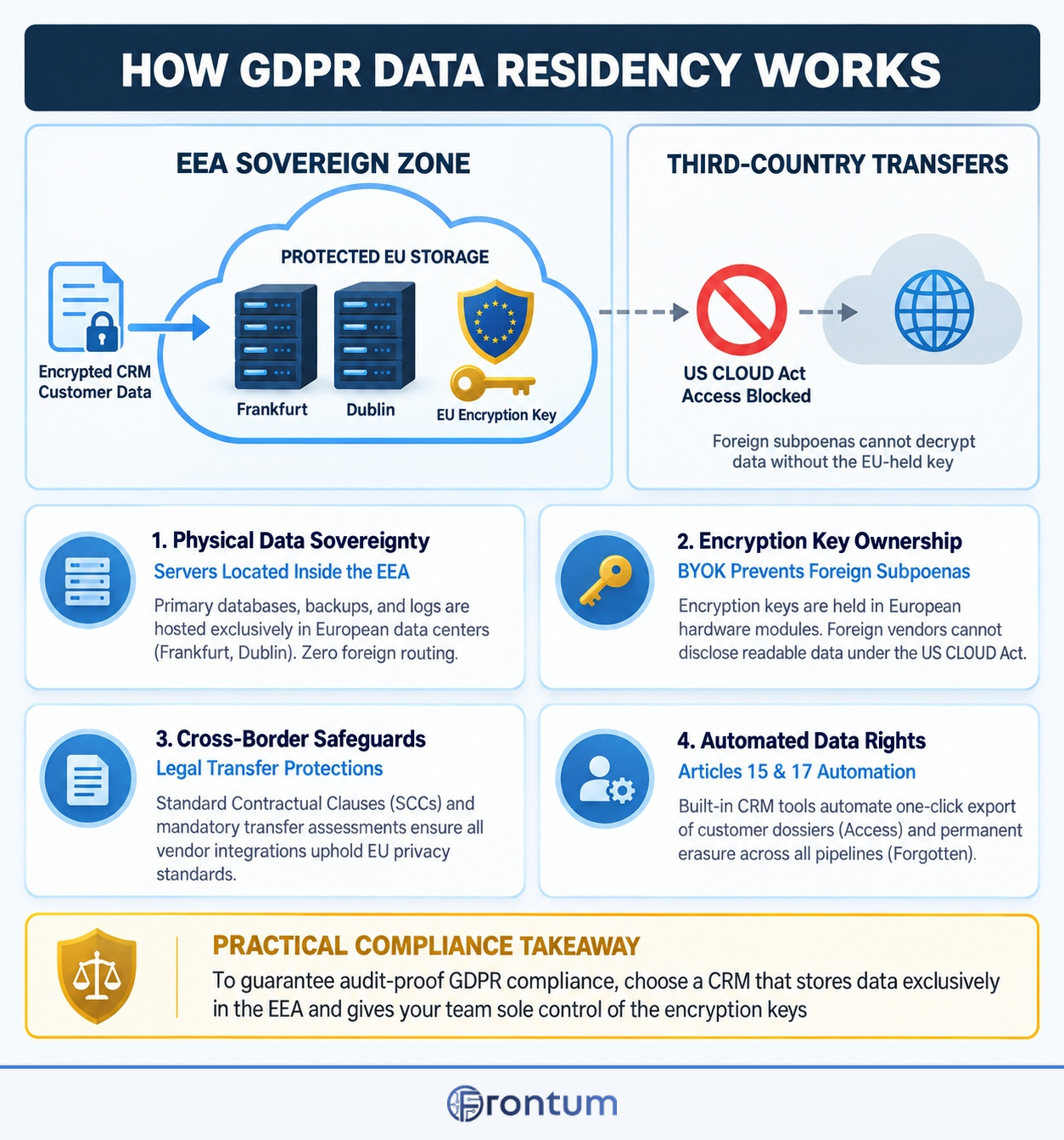
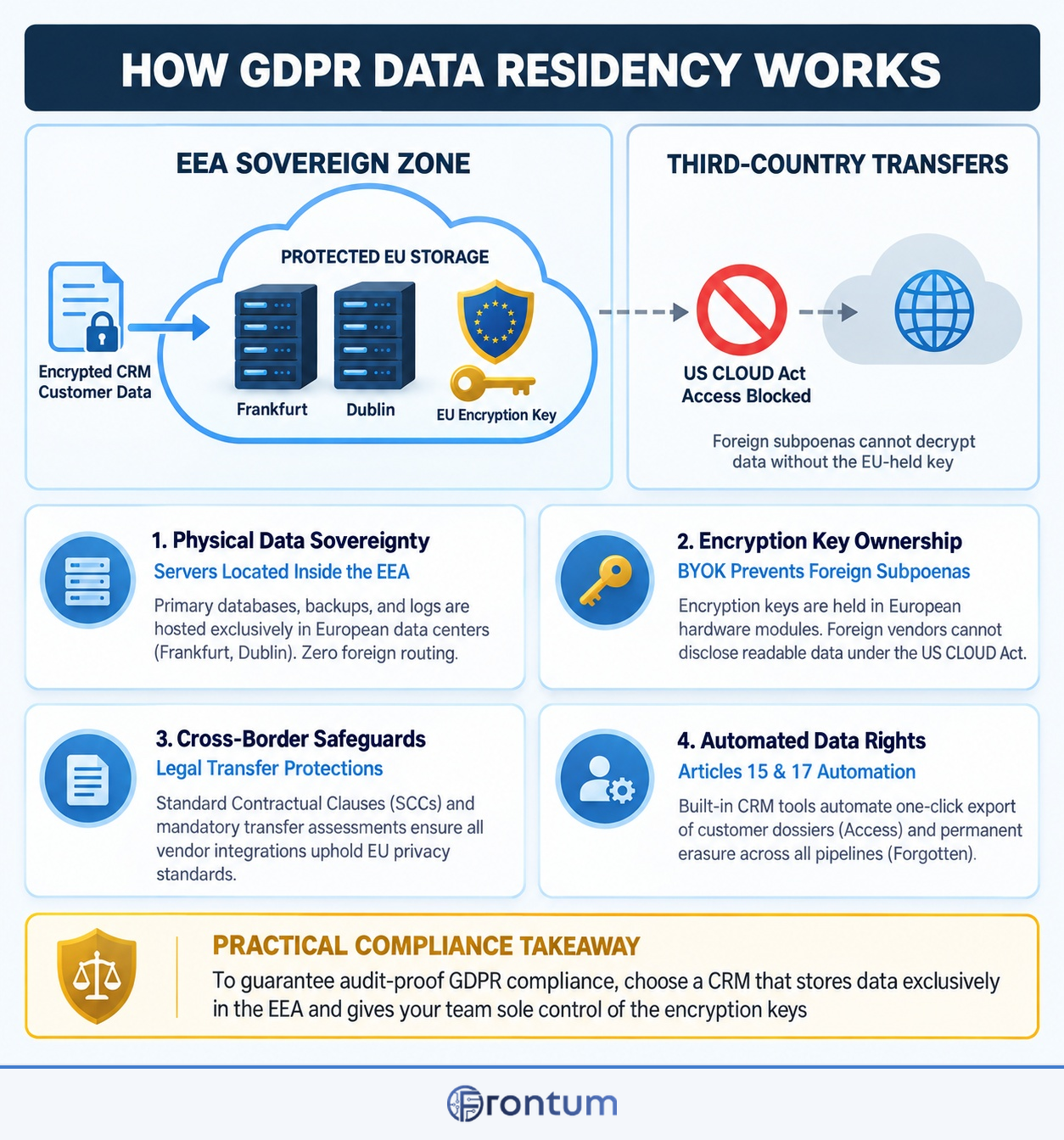
European data hosting and sovereign cloud infrastructure ensure GDPR compliance by guaranteeing that customer records, communications, and commercial contracts reside strictly within data centers located in the European Economic Area. Geographic containment eliminates cross-border data transfer vulnerabilities and shields European organizations from foreign surveillance mandates like the US CLOUD Act.
Regional European CRM providers such as Teamleader, Karlia, Axonaut, and Sellsy host infrastructure exclusively within European data centers operated by providers like Hetzner, Scaleway, or OVHcloud in Germany and France. Enterprise vendors like Pipedrive and Zoho CRM offer designated European data centers in Frankfurt and Dublin, allowing EU customers to isolate their databases upon setup. In contrast, US cloud platforms often rely on the EU-US Data Privacy Framework, which remains subject to legal challenges.
Maintaining data residency within the European Union simplifies compliance audits and reassures privacy-conscious institutional buyers. When commercial data never crosses international borders, legal teams avoid drafting complex standard contractual clauses and maintain clear alignment with Article 44 GDPR data transfer restrictions.
Multilingual client communications and localized invoicing formats include the following:
- Localized multilingual email templates and snippets: Reusable email templates and communication snippets stored in multiple European languages including English, German, French, Italian, Spanish, and Dutch. Representatives can communicate with international prospects in their native language with pre-approved, professional terminology.
- Multi-currency pipeline and exchange rate tracking: Sales opportunity tracking supporting major world currencies such as EUR, GBP, USD, and CHF with automatic or manual exchange rate conversion. Multi-currency management enables multinational sales teams to quote deals in local currencies while aggregating revenue forecasts into corporate base currency.
- European VAT and tax-compliant invoice generation: Native document creation adhering to European fiscal standards, including reverse-charge VAT handling, intra-community tax rules, and local company registration numbers. Generating compliant invoices protects cross-border businesses from European tax audits and penalty fines.
- Region-specific date, number, and address formatting: Configurable system locales that format currency symbols, comma/decimal separators, telephone dialing prefixes, and postal codes according to specific national standards. Localized formatting prevents customer confusion on commercial proposals and formal service contracts.
- Integrated European payment gateways: Native integration with popular European payment processors and banking methods such as SEPA Direct Debit, iDEAL, Bancontact, and Sofort alongside credit cards. Supporting local payment preferences increases checkout completion rates and accelerates invoice settlements.
- Localized legal disclaimers and privacy notices: Automated inclusion of country-specific legal notices, commercial registry numbers, and GDPR consent checkboxes on commercial quotes and web forms. Embedding compliant statutory disclaimers ensures commercial correspondence adheres to local trade regulations.
- Multilingual client portal and document interfaces: Self-service web portals and proposal signing interfaces that adapt to the client's preferred European language. Providing localized signing experiences builds trust with continental European corporate buyers during high-stakes contract negotiations.
What security audits, ISO certifications, and data processing agreements are required?
Enterprise CRM deployments require rigorous third-party security audits, ISO certifications, and formal Data Processing Agreements to verify that vendor systems satisfy international standards for information security, encryption, and regulatory accountability. Independent audits provide legal and compliance teams with objective proof of operational controls.
Leading CRM platforms maintain current ISO 27001 certifications and SOC 2 Type II compliance reports, verifying that physical data centers and cloud environments enforce access restrictions and vulnerability patching. Vendors must provide legally binding Data Processing Agreements incorporating Standard Contractual Clauses, automated 72-hour breach notification procedures, and clear protocols for fulfilling customer data deletion requests under Article 17 GDPR. At the application level, buyers require AES-256 encryption at rest and TLS 1.3 in transit.
Procurement departments should request recent independent audit summaries and review sub-processor lists before executing vendor contracts. Establishing transparent compliance documentation protects organizations against regulatory fines and ensures that confidential customer information remains safeguarded against cybersecurity threats.
What should European businesses evaluate when choosing a regional CRM provider?
When choosing a regional CRM provider, European businesses should evaluate the following factors:
- Guaranteed European sovereign data residency: Customer personal records, communication histories, and disaster recovery archives must be stored exclusively within ISO 27001-certified data centers located inside the EU/EEA. Providers must legally commit that data will not be routed through foreign cloud infrastructures subject to extraterritorial surveillance legislation like the US CLOUD Act. Clear regional data residency protects European organizations from conflicting legal jurisdictions and severe cross-border data transfer liabilities.
- Turnkey GDPR compliance tools: Built-in consent tracking modules, automated data retention policies, and streamlined right-to-erasure workflows simplify ongoing compliance with Article 17 of the GDPR. The platform should automatically log lawful processing grounds, cookie consent choices, and marketing opt-ins across all inbound lead generation forms. Manual compliance workflows across sprawling databases introduce severe operational risks of regulatory audits and non-compliance fines.
- Legally binding Data Processing Agreement under EU law: The vendor must execute a comprehensive DPA compliant with Article 28 of the GDPR, featuring exhaustive sub-processor disclosures and legally binding breach notification guarantees within 72 hours. The governing law and jurisdiction of the contract must reside within an EU member state court rather than a foreign jurisdiction. Procurement teams must scrutinize sub-processor chains to confirm that third-party analytics and email delivery partners maintain equivalent European privacy safeguards.
- European VAT, electronic invoicing, and currency handling: Proposal and invoicing modules must support intra-community VAT rules, automated reverse-charge calculations, and multi-currency billing across euros, pounds, and Swiss francs. Leading regional platforms offer native integration with mandatory European electronic invoicing standards such as PEPPOL, Factur-X, and ZUGFeRD. Built-in compliance with national electronic billing mandates eliminates the need for expensive third-party tax calculation add-ons.
- Native multilingual platform and local customer support: The user interface and client-facing booking pages must support multi-language localizations, including German, French, Spanish, Italian, and Dutch, for cross-border operations. Customer support teams should provide knowledgeable assistance during standard Central European business hours in regional languages rather than relying solely on US-based support centers. Local language support minimizes implementation misunderstandings and ensures rapid troubleshooting during critical business operations.
- Independent European security certifications: Verification of rigorous industry security standards, including certified ISO 27001, SOC 2 Type II, and German BSI C5 frameworks, confirms robust technical and organizational security controls. Vendors should demonstrate end-to-end encryption for data in transit and at rest using modern cryptographic standards managed under European key sovereignty. Independent third-party audit reports provide essential proof of security integrity for corporate risk assessment committees.
- Integration with regional business software ecosystems: Native connectors for European banking networks via PSD2/open banking APIs, regional accounting software like DATEV or Pennylane, and local ERP systems prevent operational silos. Interoperability with regional business tools ensures customer payments and transaction records reconcile automatically without manual export-import routines. Selecting a vendor committed to the European business software landscape guarantees seamless compatibility with national regulatory standards.