
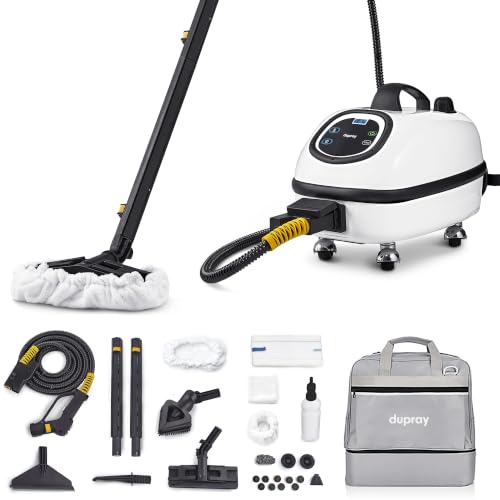
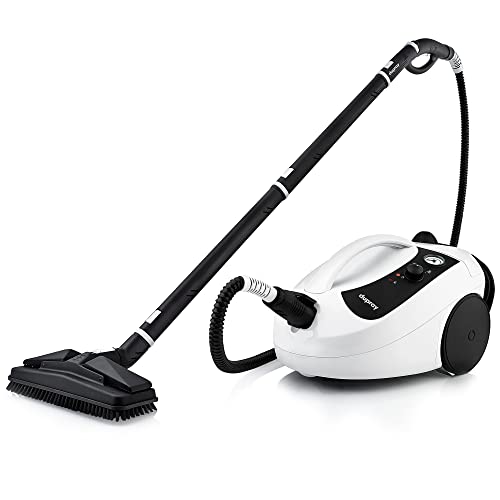
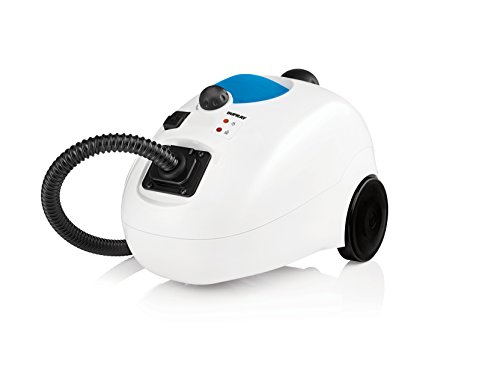


Are Dupray steam cleaners good?
Dupray steam cleaners have an average overall score of 8, ranking #2 among comparable steam-cleaner brands, and a user rating of 8.8, placing them at #5 based on user reviews.
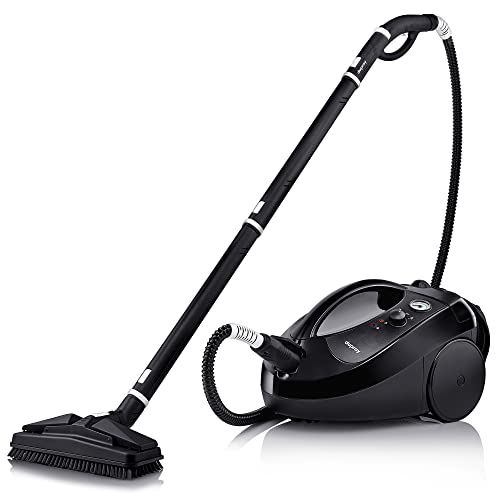
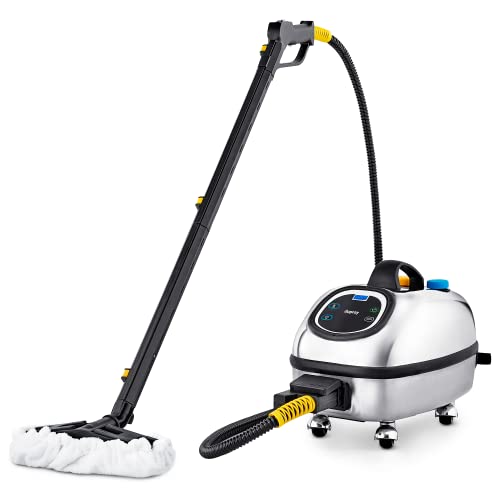
Dupray steam cleaners are particularly strong for buyers who want a hose-connected canister with a large stainless-steel boiler and a broad tool set. Neat and Home cover household floors and detail work, while One Plus adds 4.5 bar pressure and continuous refilling for longer sessions.
Dupray steam cleaners are less compelling when low weight or instant readiness matters most: compact models still weigh about 4–5 kg, several take around 8 minutes to heat, and Tosca or Hill Injection weigh 12–13 kg. Their extra capacity is worthwhile for sustained work, not occasional spot cleaning.
The best Dupray steam cleaners are as follows:
- Dupray One Plus DUP200UK Overall score: 8.19 points
- Dupray Neat Overall score: 8.03 points
- Dupray Neat Plus Overall score: 8.03 points
The following chart compares steam-cleaner brands by their average overall scores.
[horizontal-chart-13425778161684740680005134738734482881941662932445]What are the main advantages of Dupray steam cleaners?
The main advantages of Dupray steam cleaners are as follows:
- Large household boilers: Neat uses a 1.6 litre stainless-steel boiler and can provide about 50 minutes of steam, so it can cover several rooms with fewer pauses than a 200–500 ml handheld. One Plus raises total water capacity to 2.44 litres and supports continuous refilling for longer work.
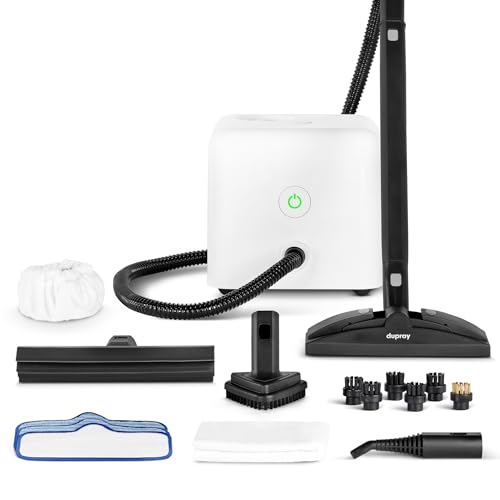
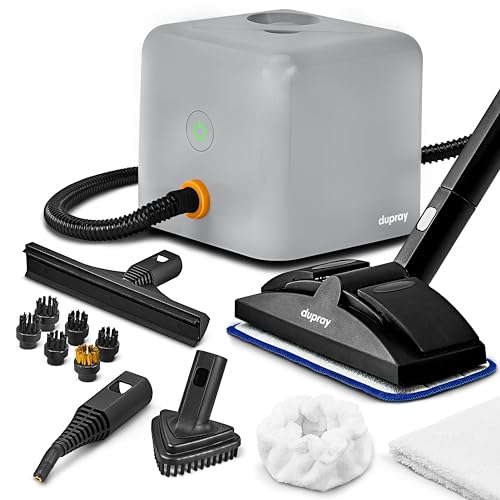
- Broad accessory packages: Neat and Neat Plus include about 17 accessories, Home around 14, One about 16 and Tosca around 25. Floor tools, jet nozzles, brushes and fabric accessories let one canister handle more surfaces, provided the required tool is included in the exact package.
- Useful hose reach: household Dupray models provide roughly 1.7–2.0 m hoses, keeping the hot body on the floor while the user works on showers, upholstery or stairs. This is more comfortable for extended detail cleaning than repeatedly lifting a handheld body.
- Durable boiler construction: the Neat, Home, One, One Plus, Tosca and Hill Injection models use stainless-steel boilers. Stainless steel supports repeated heating and is a meaningful advantage for frequent use, although it still requires correct water care and descaling.
- Clear progression to heavier workloads: Neat and Home suit ordinary household cleaning, One Plus adds 4.5 bar pressure and continuous refill, and Tosca or Hill Injection target longer professional sessions. Buyers can increase capacity and duty cycle without changing to a completely different cleaning system.
What are the main disadvantages of Dupray steam cleaners?
The main disadvantages of Dupray steam cleaners are as follows:
- Slow heat-up on several models: Neat, Home and One take roughly 8 minutes to become ready, while One Plus takes about 6 minutes and Tosca or Hill Injection around 7 minutes. Neat Plus is the quick exception at about 90 seconds, so buyers wanting immediate spot cleaning need to choose carefully.
- Canister weight: Neat and Home weigh about 4 kg and Neat Plus about 5 kg before accessories, while One reaches about 10 kg and Tosca or Hill Injection 12–13 kg. The larger machines are easier to roll than lift, making stairs, cars and multi-level homes less convenient.
- Sharp price increases: household Neat, Home and Neat Plus models cost roughly £200-£300, but One and One Plus rise to around £300-£400, Tosca to about £770 and Hill Injection to around £1,500. The premium is difficult to justify unless longer sessions or commercial durability generate real value.
- Limited integrated scale management: most Dupray household models do not provide an automatic descaling system. Their stainless-steel boilers still need the specified water and maintenance routine, especially in hard-water areas where scale can slow heating and reduce steam consistency.
- Fixed-tank compromises: Home, One and One Plus use non-detachable tanks, and not every model supports continuous refilling. A large reservoir reduces stops, but filling, emptying and cooling the whole canister can be less convenient than handling a removable tank.