Scored using TVs Methodology v3.0
TVs Methodology v3.0
Mathematical & Unbiased Scoring
Products in this category are scored under Frontum TVs Methodology v3.0: the technical score from the specifications is the base, and independent expert and video reviews (up to ±0.5 points), owner opinions (up to ±0.3) and best-of lists (up to +0.3) move it up or down.
Explore TVs Methodology v3.0

Samsung QN90D 98" review: 92 specs compared

Avg. price:~£5,900Display type:Mini LEDResolution:4K (3840 x 2160)Refresh rate:100 HzEU energy label:EN. of HDMI ports:4 ports

Samsung QN90D 98" Review: Compare 92 technical specifications, 11 expert and video reviews, 55 owner opinions and 2 best-of lists to see how this product ranks in the TVs category and whether it is worth buying.
Samsung QN90D 98"
8.3/10

Overall score

Score
8.3/ 10
✕
What it is
Our main score for this model, 1–10. It combines specs, best-of lists, expert reviews, ratings from across the web and owners.
How we count it
Parts: Technical score 45%, List score 25%, Reviews score 15%, User score 10%, Sentiment score 5%
Marks: Each part gets a mark out of 10. For reviews, lists and owners, a typical model in this category gets about 8 and the best one gets 10.
No data yet: A part with no data shows "?". It counts as the mark of a weaker model in this category (4 in 5 models with data score higher). This way, models with reviews, lists and owners usually come out ahead.
Score distribution
▼
<55-66-77-88-99-10
Score components

45%

8.2

Technical score

25%

8.1

List score

15%

8.5

Reviews score

10%

8.9

User score

5%

7.3

Sentiment score

★Better than 94% of TVs
6.1

Value for money

Value for money
6.1/ 10
✕
What it is
An indicator that combines the TV's overall rating with its price.
When it matters
When you are looking for a TV with a good balance between quality and price.
Score distribution
▼
<55-66-77-88-99-10
Score components

70%

8.3

Overall score

30%

1.0

Price

▼Worse than 96%
8.2

Technical score

Technical score
8.2/ 10
✕
What it is
How good the specs are compared with the other models in this category, 1–10.
How we count it
Areas: We rate the specs in each area against the other models in this category.
Weighting: The areas that matter most to buyers count more. The shares are shown under Score components.
Share: The technical score is 45% of the overall score.
Score distribution
▼
<55-66-77-88-99-10
Score components

35%

7.9

Picture

15%

9.1

Smart TV

13%

9.4

Connections

12%

8.4

Gaming

12%

9.0

Sound

7%

4.7

Energy

6%

7.0

Design

▲Better than 80%
8.5

Reviews score

Reviews score
8.5/ 10
✕
What it is
Average grade from independent test sites, magazines and video reviewers, 1–10.
How we count it
Grades: Each review's own score is converted to 1–10; without one, we grade the review ourselves. Big test sites count more, short reviews half as much as full tests. A video review counts half.
Score: The average grade is 80% of the review mark; the number of reviews is the other 20% (1 review = 5, the typical number in this category = 8, the most-reviewed model = 10).
Enough data: With few reviews, the average grade is pulled toward the typical grade of this category. No reviews yet: 7.7 for now.
Share: Reviews count 15% of the overall score.
Score distribution
▼
<55-66-77-88-99-10

80%

8.3

Average grade

20%

9.3

Popularity

Grades by review (11)
11 video reviews, each counting half as much as a written test. Reviews count 15% of the overall score.
Ratings from across the web count in the User score, not in this score.
▲Better than 70%
7.3

Sentiment score

Sentiment score
7.3/ 10
✕
What it is
How positive owners are about this model in their comments under video reviews and on forums. We read each comment, keep only people who say they own the model, and sort them into positive, mixed or negative.
How we count it
Score: We compare how satisfied this model’s owners are with the other models in this category: the typical model gets 8, the most satisfied tenth 10, the least satisfied 4. This is 80% of the owner mark; the number of owners is the other 20%.
Enough data: A model counts with 10+ owners from 4+ different discussions. With fewer, the owner part changes nothing.
Share: Owners count 5% of the overall score (left out in categories where fewer than 10 models have enough owner comments).
Score distribution
▼
<55-66-77-88-99-10

80%

7.0

Satisfaction

20%

8.5

Popularity

Owners (55)
55 owners from 10 online discussions
40% positive
13% mixed
47% negative
Category average: 43% positive
Our own analysis of online owner opinions, not a rating from any website.
▼Worse than 76%
8.9

User score

User score
8.9/ 10
✕
What it is
How happy buyers are with this model, based on ratings from across the web.
How we count it
Enough data: A model needs at least 1 rating from across the web. Without one, it counts as 7.8, the mark of a weaker rated model in this category.
Share: User score counts 10% of the overall score.
Score distribution
▼
<55-66-77-88-99-10

70%

8.8

Rating

30%

9.2

Popularity

▲Better than 83%
8.1

List score

List score
8.1/ 10
✕
What it is
How often independent test sites, magazines and video reviewers put this model in their best-of lists for this category.
How we count it
Points: The model in the most lists of this category gets 10; the others get 8 to 10 in proportion. In no list yet: 7.5. Lists count 25% of the overall score.
Enough data: Every list counts, even a single one. With fewer than 5 best-of lists in the category, this part is left out.
Lists with this model (2)
List score: in 2 of 97 lists (2%)
★Better than 92%
  • samsung-qn90d-98
samsung-qn90d-98
Where to buy
*As an Amazon Associate, we earn from qualifying purchases.
Best rankings
Available: ranking among products currently available (including other versions of this product).All: ranking among all products in the database.

What reviewers say about the Samsung QN90D 98"

Based on 0 · 13

Reviewers love the bright, contrasty picture on a huge screen, but find it expensive, with weak sound and a disappointing remote.
Praised
Mixed views
Criticised
Pick a topic to see who said what

What owners say about the Samsung QN90D 98"

Based on 55 owners sharing their experience in online comments

40%positive13%mixed47%negative

Owners praise the vivid, bright picture, but panel failures, blooming, and frustrating software undermine confidence.

What owners dislike

  • Several owners report the screen failed within months, with issues like black lines, dark patches or the TV not turning on.9
  • Owners say the screen is too bright at high settings, causing eye strain in the evening.8
  • Owners say Samsung refused returns outside a short window and only offered repairs.7
  • Owners find the menus and smart software slow and cluttered, with many ads. They say the Tizen system gets worse over time and the Solar remote is hard to use.5
  • Owners report strong blooming and backlight bleed, especially on dark scenes and off-angle viewing. Some say adjusting backlight settings does not fix it.5
  • Owners say glare and reflections are strong, and the anti-reflective layer can cause a rainbow effect across the screen. Some see dark corners on the screen.5
  • Owners say fast motion looks poor, with judder, ghosting and black smearing, especially when using the TV as a monitor. Some saw frame drops in slow football scenes.5
  • Owners report audio dropping out after a short time on standby, and devices like Sky boxes not being recognised. Some also had eARC connection problems.5
  • Owners find the Solar remote awkward and unreliable, with some saying it is not user friendly. Some ask whether a standard universal remote will work.4
  • Owners report fragile panels, including cracked screens, dead pixels and a panel coming loose. Some say the build quality feels poor for the price.4

Points mentioned by at least 3 owners, most mentioned first.

Loading...
Loading category ranking...

Technical Specifications of TV Samsung QN90D 98"

Technical score
Technical score
8.2/ 10
✕
What it is
How good the specs are compared with the other models in this category, 1–10.
How we count it
Areas: We rate the specs in each area against the other models in this category.
Weighting: The areas that matter most to buyers count more. The shares are shown under Score components.
Share: The technical score is 45% of the overall score.
Score distribution
▼
<55-66-77-88-99-10
Score components:

35%

7.9

Picture

15%

9.1

Smart TV

13%

9.4

Connections

12%

8.4

Gaming

12%

9.0

Sound

7%

4.7

Energy

6%

7.0

Design

8.2
Reviews score
8.5
Sentiment score
7.3
User score
8.9
List score
8.1
Value for money
Value for money
6.1/ 10
✕
What it is
An indicator that combines the TV's overall rating with its price.
When it matters
When you are looking for a TV with a good balance between quality and price.
Score distribution
▼
<55-66-77-88-99-10
Score components:

70%

8.3

Overall score

30%

1.0

Price

6.1
Display type
Mini LED
This TV uses Mini LED display technology, which is more advanced than 73% of TVs and the same as in 16.8% of TVs.
Screen size
98 inches
Resolution
4K (3840x 2160)
This TV has a resolution of 4K (3840x2160), which is sharper than 26.9% of TVs and the same as in 73.1% of TVs.
Pixel density
45 ppi
This TV has a pixel density of 45 ppi, which is lower than 96.5% of TVs and equal to 2% of TVs.
Bit depth
?
Show more
What reviewers say
Refresh rate
100 Hz
This TV has a refresh rate of 100 Hz, which is higher than 63.2% of TVs and equal to 1.6% of TVs.
N. of HDMI 2.1 ports
4 ports
This TV has HDMI 2.1 inputs totalling 4 ports, which is more than 67.5% of TVs and equal to 32.5% of TVs.
Variable refresh rate (VRR)
yes
This TV supports VRR. 5.6% of TVs offer this.
Auto low latency mode (ALLM)
yes
This TV supports ALLM. 2.4% of TVs offer this.
Input lag
?
Show more
What reviewers say
Smart TV
yes
This TV supports smart apps. 2.5% of TVs offer this.
Operating system
Tizen
Chromecast built-in
?
AirPlay support
yes
This TV supports AirPlay. 4.7% of TVs offer this.
Voice commands
yes
This TV supports voice commands. 5% of TVs offer this.
Show more
What reviewers say
N. of HDMI ports
4 ports
This TV has HDMI inputs of 4 ports, which is more than 67.9% of TVs and equal to 31.8% of TVs.
HDMI ARC / eARC
eARC
This TV offers eARC, which is more advanced than the option in 32.3% of TVs and the same as in 67.7% of TVs.
N. of USB ports
2 ports
This TV offers 2 ports for USB devices, which is more than 34.8% of TVs and equal to 58.5% of TVs.
USB version
USB 3.0
This TV offers USB 3.0, which is more advanced than the standard in 57.8% of TVs and the same as in 42.2% of TVs.
Wi-Fi connectivity
yes
This TV supports Wi-Fi. 1.8% of TVs offer this.
Show more
Audio output power
60 W
This TV has an audio output power of 60 W, which is higher than 94.9% of TVs and equal to 2.1% of TVs.
N. of speakers
?
N. of audio channels
4.2.2
Dolby Atmos support
yes
This TV supports Dolby Atmos. 2.8% of TVs offer this.
DTS:X support
?
Show more
What reviewers say
Thickness
3.1 cm
This TV has a thickness of 3.1 cm, which is thinner than 92.6% of TVs and equal to 0.7% of TVs.
Weight
61.4 kg
This TV has a weight of 61.4 kg, which is heavier than 98.8% of TVs.
Width
218.5 cm
Height
124.9 cm
VESA mount support
yes
This TV supports VESA wall mounting. 0% of TVs offer this.
Show more
What reviewers say
EU energy label
E
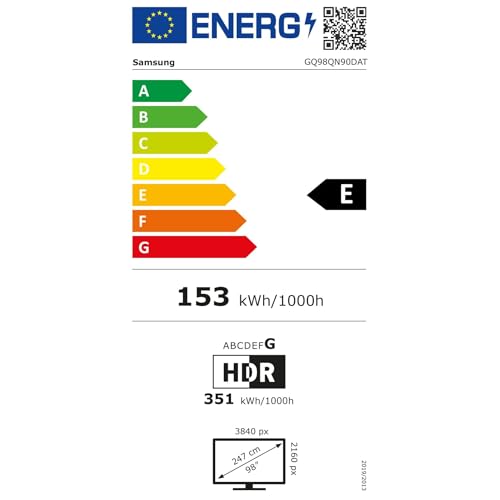
This TV has an EU energy label of E, which is more efficient than 44.7% of TVs and the same as 45.7% of TVs.
Operating power consumption
153 W
This TV has an operating power draw of 153 W, which is higher than 90.6% of TVs and equal to 0.3% of TVs.
Standby power consumption
0.5 W
This TV has a standby power draw of 0.5 W, which is lower than 1% of TVs and equal to 87.8% of TVs.
French repairability index
?

Samsung QN90D 98" vs the average TV

246810TotalPictureGamingSmart TVConnectionsSoundDesignEnergy
  • 1,600 nits higher peak brightness
    This TV has higher peak brightness than the average TV (2000 nits vs 400 nits). The average TV has a peak brightness of 400 nits.
    2,000 nits vs 400 nits
  • 40 W higher audio output power
    This TV has higher audio output power than the average TV (60 W vs 20 W). The average TV outputs 20 W.
    60 W vs 20 W
  • More advanced backlight
    This TV has a more advanced backlight than the average TV (Mini LED vs Edge LED).
    Mini LED vs Edge LED
  • 1 ports more connections
    This TV has more HDMI inputs than the average TV (4 ports vs 3 ports). The average TV has HDMI inputs of 3 ports.
    4 ports vs 3 ports
  • 2 ports more HDMI 2.1 inputs
    This TV has more HDMI 2.1 inputs than the average TV (4 ports vs 2 ports). The average TV offers 2 ports.
    4 ports vs 2 ports
  • 4.35 cm thinner body
    This TV has a thinner body than the average TV (3.1 cm vs 7.45 cm). The average TV has a thickness of 7.45 cm.
    3.1 cm vs 7.45 cm
  • 40 Hz higher refresh rate
    This TV has a higher refresh rate than the average TV (100 Hz vs 60 Hz). The average TV has a refresh rate of 60 Hz.
    100 Hz vs 60 Hz
  • More advanced USB standard
    This TV offers a more advanced USB standard than the average TV (USB 3 vs USB 2).
    USB 3.0 vs USB 2.0
  • 1,600 nits higher peak brightness
    This TV has higher peak brightness than the average TV (2000 nits vs 400 nits). The average TV has a peak brightness of 400 nits.
    2,000 nits vs 400 nits
  • More advanced backlight
    This TV has a more advanced backlight than the average TV (Mini LED vs Edge LED).
    Mini LED vs Edge LED
  • 2 ports more HDMI 2.1 inputs
    This TV has more HDMI 2.1 inputs than the average TV (4 ports vs 2 ports). The average TV offers 2 ports.
    4 ports vs 2 ports
  • 40 Hz higher refresh rate
    This TV has a higher refresh rate than the average TV (100 Hz vs 60 Hz). The average TV has a refresh rate of 60 Hz.
    100 Hz vs 60 Hz
  • 1 ports more connections
    This TV has more HDMI inputs than the average TV (4 ports vs 3 ports). The average TV has HDMI inputs of 3 ports.
    4 ports vs 3 ports
  • More advanced USB standard
    This TV offers a more advanced USB standard than the average TV (USB 3 vs USB 2).
    USB 3.0 vs USB 2.0
  • 40 W higher audio output power
    This TV has higher audio output power than the average TV (60 W vs 20 W). The average TV outputs 20 W.
    60 W vs 20 W
  • 4.35 cm thinner body
    This TV has a thinner body than the average TV (3.1 cm vs 7.45 cm). The average TV has a thickness of 7.45 cm.
    3.1 cm vs 7.45 cm
  • No Dolby Vision
    This TV does not support Dolby Vision, while the average TV does. 85.9% of TVs support Dolby Vision.
  • 89 W higher power draw
    This TV has a higher operating power draw than the average TV (153 W vs 64 W). The average TV has an operating power draw of 64 W.
    153 W vs 64 W
  • 5.58x heavier
    This TV is heavier than the average TV (61.4 kg vs 11 kg). The average TV weighs 11 kg.
    61.4 kg vs 11 kg
  • 23 ppi lower pixel density
    This TV has a lower pixel density than the average TV (45 ppi vs 68 ppi). The average TV has a pixel density of 68 ppi.
    45 ppi vs 68 ppi
  • 15.95x more expensive
    Samsung QN90D 98" is more expensive than the average TV (£5,900 vs £370).
    £5,900 vs £370
  • Less current HbbTV support
    This TV supports an older HbbTV version than the average TV (HbbTV 2.3 vs HbbTV 2.4).
    HbbTV 2.0.3 vs HbbTV 2.0.4
  • 30% worse value for money
    Samsung QN90D 98" has worse value for money than the average TV (6.08 vs 7.9).
    6.08 vs 7.9
  • 15.95x more expensive
    Samsung QN90D 98" is more expensive than the average TV (£5,900 vs £370).
    £5,900 vs £370
  • 30% worse value for money
    Samsung QN90D 98" has worse value for money than the average TV (6.08 vs 7.9).
    6.08 vs 7.9
  • No Dolby Vision
    This TV does not support Dolby Vision, while the average TV does. 85.9% of TVs support Dolby Vision.
  • 23 ppi lower pixel density
    This TV has a lower pixel density than the average TV (45 ppi vs 68 ppi). The average TV has a pixel density of 68 ppi.
    45 ppi vs 68 ppi
  • Less current HbbTV support
    This TV supports an older HbbTV version than the average TV (HbbTV 2.3 vs HbbTV 2.4).
    HbbTV 2.0.3 vs HbbTV 2.0.4
  • 5.58x heavier
    This TV is heavier than the average TV (61.4 kg vs 11 kg). The average TV weighs 11 kg.
    61.4 kg vs 11 kg
  • 89 W higher power draw
    This TV has a higher operating power draw than the average TV (153 W vs 64 W). The average TV has an operating power draw of 64 W.
    153 W vs 64 W

Video reviews

Hands-on testing, unboxing, and real-world video evaluations

9.0
TheUnlockr
≈ estimated
23/12/2024
Real-world test · full day of use across scenarios
Verdict
Samsung QN90D 98" delivers a great picture and good value at smaller and mid sizes, but its sound lacks bass and the 98-inch size is expensive.
6.0
Digital Trends
≈ estimated
19/11/2024
Hands-on review · four days of viewing and tests
Verdict
Samsung QN90D 98" looks excellent most of the time, but processing glitches and the high price hold it back.
9.5
New Stuff TV
≈ estimated
07/11/2024
Hands-on review · a few days of daily use
Verdict
Samsung QN90D 98" delivers an excellent picture, especially for upscaling and viewing angles, plus easy AI picture setup.
9.0
GadgetGuy
≈ estimated
05/08/2024
Hands-on review · picture, motion and smart features
Verdict
Samsung QN90D 98" delivers an impressive picture and a great size, though it is not perfect for every household.
5.0
Andrew Robinson
≈ estimated
21/07/2024
Hands-on review · comparison with rival and viewing angle tests
Verdict
Samsung QN90D 98" looks impressive in ideal settings, but a rival TV is more consistent and reliable day to day.
8.0
Alex Kidman
≈ estimated
04/07/2024
Hands-on review · picture modes, upscaling and gaming tests
Verdict
Samsung QN90D 98" is an impressive large TV, though black levels trail OLED and the rear connections are awkward.
9.0
Chris Stead
≈ estimated
21/06/2024
Hands-on review · picture, gaming and design tests
Verdict
Samsung QN90D 98" is a great TV worth owning, with a bright, deep-black picture and strong gaming features.
9.0
Tech Steve
≈ estimated
15/05/2024
Hands-on review · stand test and Q&A
Verdict
Samsung QN90D 98" has a bright, vivid picture that suits buyers wanting a top-quality TV, though it has some drawbacks.
9.0
Tech Steve
≈ estimated
26/03/2024
Short review · features and movie viewing
Verdict
Samsung QN90D 98" is a top Samsung pick for the average consumer, with an excellent picture.
9.0
Digital Trends
≈ estimated
26/03/2024
First look · measurements and first impressions
Verdict
Samsung QN90D 98" is expected to be a class-leading TV, though its premium price stands out.
Shop video
Overview video

Third-party reviews

What customers like about Samsung QN90D 98"

  • 2000 nits of peak brightness keeps HDR highlights bright in daylight.
  • The Mini LED backlight gives strong contrast with little blooming.
  • At 98 inches, it suits a whole group watching together.
  • At 3.1 cm deep, the screen sits close to the wall.
  • Four HDMI 2.1 ports with VRR suit a modern console.
  • eARC passes Dolby Atmos sound to a soundbar.

What customers don't like about Samsung QN90D 98"

  • At 61.4 kg it needs two people and a strong wall.
  • The 45 ppi pixel density shows the pixels when you sit close.
  • There is no Dolby Vision support.
  • Colour and brightness shift when you sit off to the side.
  • It draws 153 W in use, a lot for a TV.

Verdict

With 2000 nits of peak brightness, the Samsung QN90D 98-inch is built for a big room with daylight and a group on the sofa. HDR scenes look bright and punchy, and the 60 W speakers with Dolby Atmos handle speech well, but they lack bass. It weighs 61.4 kg, so it needs two people and a strong wall to hang. The screen is only 3.1 cm deep, and the picture stays bright with a good source. Viewing angles are narrow, so colour and brightness shift when you sit off to the side. At 45 ppi, the pixels show up close, so sit a few metres back. There is no Dolby Vision, and the set draws 153 W in use. It suits a buyer with a large, bright room and a wall that can take the weight.

Compare Samsung QN90D 98" with other TVs

1Product to compare no. 1
VS
2Product to compare no. 2
VS
3Product to compare no. 3 (optional)

Graphic comparison of Samsung QN90D 98" and other TVs

No results found