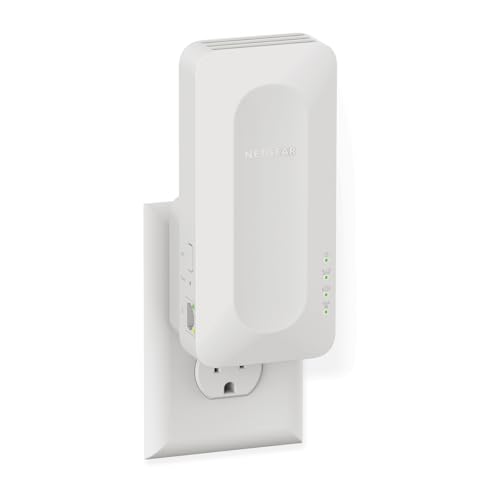
Netgear EAX14 Review | 63 Data compared

double-arrow
  • Avg. price in UK: ~£70
  • Avg. price in US: ~$80
  • Wi-Fi version: Wi-Fi 6 (802.11ax)
  • Wi-Fi speed: 1800 Mbps
  • Coverage area: 139

Netgear EAX14 review. Compare 63 technical specifications and user reviews to see how it ranks among wi-fi extenders and if it is worth buying.

7.5

Overall score

What it is: An overall evaluation of the Wi-Fi extender's quality, based on technical analyses and user reviews.

When it matters: When you need a quick reference to spot the best Wi‑Fi extenders overall.

Score components:

80.0%

7.5

Technical Score

20.0%

?

User score

Very good
7.5

Technical Score

What it is: An assessment of the Wi-Fi extender's technical performance, covering eight key areas: speed, coverage, signal stability, connectivity, Ethernet features, mesh support, ease of setup, and design.

When it matters: When you want to compare Wi‑Fi extenders based on speed, coverage, ports, and wireless features.

Score components:

40.0%

7.2

Wi-Fi Performance

30.0%

6.6

Network & Security

12.0%

10

Setup & Management

10.0%

6.5

Hardware & Deployment

8.0%

10

Ports

Very good
?

User score

What it is: A rating that combines user reviews and the total number of reviews received by the Wi-Fi extender.

When it matters: When you want to know how a Wi‑Fi extender performs in daily use and how reliably it maintains a stable connection over time according to user feedback.

Score components:

70.0%

?

User reviews

30.0%

?

Popularity

  • 4.1
    Gaming

    Score components:

    35.0%

    6.0

    Wi-Fi speed

    30.0%

    1.0

    QoS support

    20.0%

    1.0

    Ethernet backhaul

    15.0%

    10

    N. of LAN ports

  • 9.0
    Travel

    Score components:

    45.0%

    9.0

    Weight

    30.0%

    10

    Portable design

    15.0%

    6.0

    Wi-Fi speed

    10.0%

    10

    Access Point mode

  • No image
No image

Best prices in UK

    N/A~ £70

Best rankings

?

Available: ranking among products currently available (including other versions of this product).
All: ranking among all products in the database.

Verdict

The Netgear EAX14 is an AX1800 4-stream Wi-Fi 6 mesh extender that delivers combined speeds of up to 1.8 Gbps (1.2 Gbps on 5GHz and 600 Mbps on 2.4GHz) and covers up to 1,500 square feet. This dual-band wall-plug device features a 1.5GHz quad-core processor, MU-MIMO and OFDMA support for handling up to 20 devices, and WPA3 security. Its main advantages include seamless smart roaming with a single network name, backward compatibility with older Wi-Fi standards, and easy management via the Nighthawk app. However, users have noted it can be somewhat bulky, lacks a pass-through power outlet, and some may find the initial app-based setup a bit complex.

Technical Specifications of Netgear EAX14

Technical Score

What it is: An assessment of the Wi-Fi extender's technical performance, covering eight key areas: speed, coverage, signal stability, connectivity, Ethernet features, mesh support, ease of setup, and design.

When it matters: When you want to compare Wi‑Fi extenders based on speed, coverage, ports, and wireless features.

Score components:

40.0%

?

Wi-Fi Performance

30.0%

?

Network & Security

12.0%

?

Setup & Management

10.0%

?

Hardware & Deployment

8.0%

?

Ports

7.5
Netgear EAX14 has a technical score of 7.54 points, which is higher than 53.9% of Wi-Fi extenders.
User score

What it is: A rating that combines user reviews and the total number of reviews received by the Wi-Fi extender.

When it matters: When you want to know how a Wi‑Fi extender performs in daily use and how reliably it maintains a stable connection over time according to user feedback.

Score components:

70.0%

0.0

User reviews

30.0%

1.0

Popularity

?
Popularity
What it is: An indicator based on the number of reviews received by the Wi-Fi extender.
When it matters: When you prefer to buy a Wi‑Fi extender that has already been chosen and reviewed by many other users.
1.0
Netgear EAX14 has a popularity of 1 points, which is lower than 70.6% of products in this category.
Ratio quality/price

What it is: An indicator that combines the Wi-Fi extender's overall rating with its cost.

When it matters: When you are looking for a Wi‑Fi extender with a good balance between performance and price.

Score components:

60.0%

7.5

Overall score

40.0%

10

Price

8.3
Netgear EAX14 has a quality-to-price ratio of 8.3 points, which is higher than 53.9% of products in this category.
Wi-Fi version
What it is: The Wi‑Fi generation the extender supports, such as Wi‑Fi 5, Wi‑Fi 6, or Wi‑Fi 6E.
When it matters: When you want the extender to work well with newer routers and support modern wireless features.

Importance: HIGH

Wi-Fi 6 (802.11ax)
Netgear EAX14 supports Wi-Fi 6 (802.11ax), more advanced than 54.9% of Wi-Fi extenders and equal to 36.3% of Wi-Fi extenders.
Wi-Fi bands
What it is: The wireless frequency bands the extender can use.
When it matters: When your router and devices depend on support for the right Wi‑Fi bands.

Importance: HIGH

Dual-band
Netgear EAX14 supports Dual-band, more versatile than 10.8% of Wi-Fi extenders and equal to 74.5% of Wi-Fi extenders.
6 GHz band support
What it is: Whether the extender can operate on the 6 GHz band.
When it matters: When you want the extender to work well with newer routers and support modern wireless features.

Importance: LOW

no
Netgear EAX14 does not support the 6 GHz band. 5.9% of Wi-Fi extenders support the 6 GHz band.
Wi-Fi speed
What it is: The combined theoretical maximum wireless speed across the supported bands.
When it matters: When you need better speed and signal strength in rooms that are harder to reach.

Importance: HIGH

1,800 Mbps
Netgear EAX14 reaches 1800 Mbps Wi-Fi speed, faster than 52.9% of Wi-Fi extenders and equal to 5.9% of Wi-Fi extenders.
Max speed 2.4 GHz
What it is: The maximum supported wireless speed on the 2.4 GHz band.
When it matters: When you need better speed and signal strength in rooms that are harder to reach.

Importance: MEDIUM

600 Mbps
Netgear EAX14 reaches 600 Mbps on 2.4 GHz, faster than 75.5% of Wi-Fi extenders and equal to 14.7% of Wi-Fi extenders.
Show more
Ethernet backhaul
What it is: Whether the extender supports Ethernet backhaul through a wired network connection.
When it matters: When you want a more stable link over Ethernet instead of relying only on wireless repeating.

Importance: MEDIUM

no
Netgear EAX14 does not support Ethernet backhaul. 52.2% of Wi-Fi extenders support Ethernet backhaul.
Mesh compatibility
What it is: The mesh systems or ecosystems the extender can work with.
When it matters: When you want smoother roaming and more consistent coverage across your home.

Importance: LOW

Nighthawk Mesh
Mesh standard
What it is: The mesh standard or ecosystem the extender uses.
When it matters: When you want smoother roaming and more consistent coverage across your home.

Importance: LOW

proprietary mesh
Roaming feature
What it is: Whether the extender supports seamless roaming between network nodes.
When it matters: When you want smoother roaming and more consistent coverage across your home.

Importance: MEDIUM

yes
Netgear EAX14 supports roaming. 17.7% of Wi-Fi extenders support roaming.
Via Smart Roaming.
802.11k support
What it is: Whether the extender supports 802.11k for better roaming information between access points.
When it matters: When you want smoother roaming and more consistent coverage across your home.

Importance: LOW

yes
Netgear EAX14 supports 802.11k. 27.1% of Wi-Fi extenders support 802.11k.
Show more
N. of LAN ports
What it is: The number of wired LAN ports on the extender.
When it matters: When you need to connect wired devices such as TVs, consoles, PCs, or switches.

Importance: MEDIUM

1
Netgear EAX14 has 1 LAN port/s, more than 8.1% of Wi-Fi extenders and equal to 76.8% of Wi-Fi extenders.
Ethernet port speed
What it is: The maximum Ethernet speed supported by the wired ports.
When it matters: When you connect wired devices and want them to run at full local network speed.

Importance: MEDIUM

1 Gbps
Netgear EAX14 offers 1 Gbps Ethernet speed, faster than 25.7% of Wi-Fi extenders and equal to 64.4% of Wi-Fi extenders.
N. of USB ports
What it is: The number of USB ports on the extender.
When it matters: When you need to connect wired devices such as TVs, consoles, PCs, or switches.

Importance: LOW

0
Netgear EAX14 has 0 USB port/s, equal to 97.1% of Wi-Fi extenders.
PoE standard
What it is: The Power over Ethernet standard the extender supports, if any.
When it matters: When you want to power the extender over Ethernet instead of using a separate power adapter.

Importance: LOW

N/A
Dedicated smartphone app
What it is: Whether the extender can be managed through a dedicated smartphone app.
When it matters: When you want easier setup, monitoring, and control from your phone.

Importance: MEDIUM

yes
Netgear EAX14 comes with a dedicated smartphone app. 15.2% of Wi-Fi extenders come with a dedicated smartphone app.
Nighthawk app.
Web UI management
What it is: Whether the extender offers a web-based interface for setup and management.
When it matters: When you prefer advanced setup and control from a web browser.

Importance: MEDIUM

yes
Netgear EAX14 has a web management interface. 2% of Wi-Fi extenders have a web management interface.
Web UI at mywifiext.net.
Automatic firmware updates
What it is: Whether the extender can install firmware updates automatically.
When it matters: When you want security and stability updates without having to manage them manually.

Importance: LOW

yes
Netgear EAX14 has automatic firmware updates. 53.1% of Wi-Fi extenders have automatic firmware updates.
LED control
What it is: Whether the extender’s LED indicators can be adjusted or turned off.
When it matters: When the extender sits in a bedroom or another space where bright status lights can be annoying.

Importance: LOW

yes
Netgear EAX14 has LED control. 12.1% of Wi-Fi extenders have LED control.
Buttons present
What it is: The physical buttons available on the extender, such as reset, power, or WPS.
When it matters: When you prefer direct physical controls instead of relying only on software menus.

Importance: LOW

wps, reset
Show more
Mounting type
What it is: The mounting style the extender uses, such as wall-plug or desktop placement.
When it matters: When the extender needs to fit neatly into a tight space, behind furniture, or near an outlet.

Importance: LOW

wall-plug
Portable design
What it is: Whether the extender has a travel-friendly portable design, usually a compact plug-in form factor rather than a larger desktop or fixed-installation unit.
When it matters: When you want an extender that is easy to pack, move between locations, or use temporarily while travelling.

Importance: LOW

yes
Netgear EAX14 has a portable design. 34.3% of Wi-Fi extenders have a portable design.
Derived from compact plug-in form factor.
Height
What it is: The height of the extender body.
When it matters: When the extender needs to fit neatly into a tight space, behind furniture, or near an outlet.

Importance: LOW

149 mm
Netgear EAX14 is 149 mm tall, taller than 61.8% of Wi-Fi extenders and equal to 5.9% of Wi-Fi extenders.
Width
What it is: The width of the extender body.
When it matters: When the extender needs to fit neatly into a tight space, behind furniture, or near an outlet.

Importance: LOW

68.4 mm
Netgear EAX14 is 68.4 mm wide, narrower than 82.4% of Wi-Fi extenders and equal to 3.9% of Wi-Fi extenders.
Thickness
What it is: The depth or thickness of the extender body.
When it matters: When the extender needs to fit neatly into a tight space, behind furniture, or near an outlet.

Importance: LOW

52.3 mm
Netgear EAX14 is 52.3 mm thick, thicker than 63.7% of Wi-Fi extenders and equal to 3.9% of Wi-Fi extenders.
Show more

Netgear EAX14 vs the average wi-fi extender

  • Supports OFDMA
    Netgear EAX14 supports OFDMA, while the average wi-fi extender does not. 45.6% of Wi-Fi extenders support OFDMA.
    DL/UL OFDMA.
    What it is: Whether the extender supports OFDMA to improve efficiency when many devices are connected.
    When it matters: When many phones, laptops, TVs, and smart-home devices are online at the same time.

    Importance: MEDIUM

    Netgear EAX14 supports OFDMA, while the average wi-fi extender does not. 45.6% of Wi-Fi extenders support OFDMA.
  • 150 Mbps faster 2.4 GHz speed
    Netgear EAX14 reaches a faster 2.4 GHz speed than the average wi-fi extender (600 Mbps vs 450 Mbps). The average Wi-Fi extender reaches 450 Mbps on 2.4 GHz.
    What it is: The maximum supported wireless speed on the 2.4 GHz band.
    When it matters: When you need better speed and signal strength in rooms that are harder to reach.

    Importance: MEDIUM

    Netgear EAX14 reaches a faster 2.4 GHz speed than the average wi-fi extender (600 Mbps vs 450 Mbps). The average Wi-Fi extender reaches 450 Mbps on 2.4 GHz.600 Mbps vs 450 Mbps
  • Automatic firmware updates
    Netgear EAX14 has automatic firmware updates, while the average wi-fi extender does not. 47.5% of Wi-Fi extenders have automatic firmware updates.
    What it is: Whether the extender can install firmware updates automatically.
    When it matters: When you want security and stability updates without having to manage them manually.

    Importance: LOW

    Netgear EAX14 has automatic firmware updates, while the average wi-fi extender does not. 47.5% of Wi-Fi extenders have automatic firmware updates.
  • 8x more flash storage
    Netgear EAX14 has more flash storage than the average wi-fi extender (128 MB vs 16 MB). The average Wi-Fi extender has 16 MB of flash storage.
    What it is: The amount of built-in flash storage used for firmware and saved settings.
    When it matters: When you want the extender to stay responsive and capable over the long term.

    Importance: LOW

    Netgear EAX14 has more flash storage than the average wi-fi extender (128 MB vs 16 MB). The average Wi-Fi extender has 16 MB of flash storage.128 MB vs 16 MB
  • Supports BSS coloring
    Netgear EAX14 supports BSS coloring, while the average wi-fi extender does not. 45.6% of Wi-Fi extenders support BSS coloring.
    What it is: Whether the extender supports BSS coloring to reduce interference in crowded Wi‑Fi environments.
    When it matters: When your home or office has many nearby networks that can cause interference and congestion.

    Importance: LOW

    Netgear EAX14 supports BSS coloring, while the average wi-fi extender does not. 45.6% of Wi-Fi extenders support BSS coloring.
  • Supports Target Wake Time
    Netgear EAX14 supports Target Wake Time, while the average wi-fi extender does not. 44.1% of Wi-Fi extenders support Target Wake Time.
    What it is: Whether the extender supports Target Wake Time to help connected devices reduce power use.
    When it matters: When many phones, laptops, TVs, and smart-home devices are online at the same time.

    Importance: LOW

    Netgear EAX14 supports Target Wake Time, while the average wi-fi extender does not. 44.1% of Wi-Fi extenders support Target Wake Time.
  • 13 mm narrower width
    Netgear EAX14 is narrower than the average wi-fi extender (68.4 mm vs 81.4 mm). The average Wi-Fi extender has a width of 81.4 mm.
    What it is: The width of the extender body.
    When it matters: When the extender needs to fit neatly into a tight space, behind furniture, or near an outlet.

    Importance: LOW

    Netgear EAX14 is narrower than the average wi-fi extender (68.4 mm vs 81.4 mm). The average Wi-Fi extender has a width of 81.4 mm.68.4 mm vs 81.4 mm
  • 1.4% faster Wi-Fi speed
    Netgear EAX14 reaches faster Wi-Fi speed than the average wi-fi extender (1,800 Mbps vs 1,775 Mbps). The average Wi-Fi extender reaches 1,775 Mbps Wi-Fi speed.
    What it is: The combined theoretical maximum wireless speed across the supported bands.
    When it matters: When you need better speed and signal strength in rooms that are harder to reach.

    Importance: HIGH

    Netgear EAX14 reaches faster Wi-Fi speed than the average wi-fi extender (1,800 Mbps vs 1,775 Mbps). The average Wi-Fi extender reaches 1,775 Mbps Wi-Fi speed.1800 Mbps vs 1775 Mbps
  • Supports OFDMA
    Netgear EAX14 supports OFDMA, while the average wi-fi extender does not. 45.6% of Wi-Fi extenders support OFDMA.
  • 150 Mbps faster 2.4 GHz speed
    Netgear EAX14 reaches a faster 2.4 GHz speed than the average wi-fi extender (600 Mbps vs 450 Mbps). The average Wi-Fi extender reaches 450 Mbps on 2.4 GHz.
  • Supports BSS coloring
    Netgear EAX14 supports BSS coloring, while the average wi-fi extender does not. 45.6% of Wi-Fi extenders support BSS coloring.
  • Supports Target Wake Time
    Netgear EAX14 supports Target Wake Time, while the average wi-fi extender does not. 44.1% of Wi-Fi extenders support Target Wake Time.
  • 1.4% faster Wi-Fi speed
    Netgear EAX14 reaches faster Wi-Fi speed than the average wi-fi extender (1,800 Mbps vs 1,775 Mbps). The average Wi-Fi extender reaches 1,775 Mbps Wi-Fi speed.
  • Automatic firmware updates
    Netgear EAX14 has automatic firmware updates, while the average wi-fi extender does not. 47.5% of Wi-Fi extenders have automatic firmware updates.
  • 8x more flash storage
    Netgear EAX14 has more flash storage than the average wi-fi extender (128 MB vs 16 MB). The average Wi-Fi extender has 16 MB of flash storage.
  • 13 mm narrower width
    Netgear EAX14 is narrower than the average wi-fi extender (68.4 mm vs 81.4 mm). The average Wi-Fi extender has a width of 81.4 mm.
  • 4.1% smaller coverage area
    Netgear EAX14 covers a smaller area than the average wi-fi extender (139 m² vs 145 m²). The average Wi-Fi extender covers 145 m².
  • 11 fewer connected devices
    Netgear EAX14 supports fewer connected devices than the average wi-fi extender (20 vs 31). The average Wi-Fi extender supports up to 31 connected devices.
    Recommended maximum.
  • No Ethernet backhaul
    Netgear EAX14 does not support Ethernet backhaul, while the average wi-fi extender does. 51.6% of Wi-Fi extenders support Ethernet backhaul.
  • No QoS support
    Netgear EAX14 does not support QoS, while the average wi-fi extender does. 57.4% of Wi-Fi extenders support QoS.
  • 2.5 W higher power consumption
    Netgear EAX14 uses more power than the average wi-fi extender (12 W vs 9.5 W). The average Wi-Fi extender uses 9.5 W of power.
  • 6.3 mm thicker
    Netgear EAX14 is thicker than the average wi-fi extender (52.3 mm vs 46 mm). The average Wi-Fi extender has a thickness of 46 mm.
  • 27 mm taller
    Netgear EAX14 is taller than the average wi-fi extender (149 mm vs 122 mm). The average Wi-Fi extender has a height of 122 mm.
  • No Ethernet backhaul
    Netgear EAX14 does not support Ethernet backhaul, while the average wi-fi extender does. 51.6% of Wi-Fi extenders support Ethernet backhaul.
    What it is: Whether the extender supports Ethernet backhaul through a wired network connection.
    When it matters: When you want a more stable link over Ethernet instead of relying only on wireless repeating.

    Importance: MEDIUM

    Netgear EAX14 does not support Ethernet backhaul, while the average wi-fi extender does. 51.6% of Wi-Fi extenders support Ethernet backhaul.
  • No QoS support
    Netgear EAX14 does not support QoS, while the average wi-fi extender does. 57.4% of Wi-Fi extenders support QoS.
    What it is: Whether the extender supports Quality of Service to prioritize certain traffic.
    When it matters: When the extender needs to fit cleanly into a more advanced network setup.

    Importance: MEDIUM

    Netgear EAX14 does not support QoS, while the average wi-fi extender does. 57.4% of Wi-Fi extenders support QoS.
  • 2.5 W higher power consumption
    Netgear EAX14 uses more power than the average wi-fi extender (12 W vs 9.5 W). The average Wi-Fi extender uses 9.5 W of power.
    What it is: The power the extender typically uses during normal operation.
    When it matters: When you care about energy use, heat output, or running costs.

    Importance: LOW

    Netgear EAX14 uses more power than the average wi-fi extender (12 W vs 9.5 W). The average Wi-Fi extender uses 9.5 W of power.12 W vs 9.5 W
  • 4.1% smaller coverage area
    Netgear EAX14 covers a smaller area than the average wi-fi extender (139 m² vs 145 m²). The average Wi-Fi extender covers 145 m².
    What it is: The estimated area the extender is designed to cover.
    When it matters: When you need better speed and signal strength in rooms that are harder to reach.

    Importance: HIGH

    Netgear EAX14 covers a smaller area than the average wi-fi extender (139 m² vs 145 m²). The average Wi-Fi extender covers 145 m².139 m² vs 145 m²
  • 11 fewer connected devices
    Netgear EAX14 supports fewer connected devices than the average wi-fi extender (20 vs 31). The average Wi-Fi extender supports up to 31 connected devices.
    Recommended maximum.
    What it is: The maximum number of client devices the extender is designed to handle at once.
    When it matters: When many phones, laptops, TVs, and smart-home devices are online at the same time.

    Importance: MEDIUM

    Netgear EAX14 supports fewer connected devices than the average wi-fi extender (20 vs 31). The average Wi-Fi extender supports up to 31 connected devices.20 vs 31
  • 10x less popular
    Netgear EAX14 has a lower popularity than the average wi-fi extender (1.00 vs 10.000).
    What it is: An indicator based on the number of reviews received by the Wi-Fi extender.
    When it matters: When you prefer to buy a Wi‑Fi extender that has already been chosen and reviewed by many other users.
    Netgear EAX14 has a lower popularity than the average wi-fi extender (1.00 vs 10.000).1 vs 10
  • 6.3 mm thicker
    Netgear EAX14 is thicker than the average wi-fi extender (52.3 mm vs 46 mm). The average Wi-Fi extender has a thickness of 46 mm.
    What it is: The depth or thickness of the extender body.
    When it matters: When the extender needs to fit neatly into a tight space, behind furniture, or near an outlet.

    Importance: LOW

    Netgear EAX14 is thicker than the average wi-fi extender (52.3 mm vs 46 mm). The average Wi-Fi extender has a thickness of 46 mm.52.3 mm vs 46 mm
  • 2.3% lower user score
    Netgear EAX14 has a lower user score than the average wi-fi extender (8.00 vs 8.180).
    What it is: A rating that combines user reviews and the total number of reviews received by the Wi-Fi extender.
    When it matters: When you want to know how a Wi‑Fi extender performs in daily use and how reliably it maintains a stable connection over time according to user feedback.
    Netgear EAX14 has a lower user score than the average wi-fi extender (8.00 vs 8.180).8 vs 8.18

Graphic comparison of Netgear EAX14 and

Attribute category
Attribute
No results found

Third-party reviews

What customers like about Netgear EAX14?

  • Significantly boosts WiFi signal strength and eliminates dead zones in areas like basements and garages
  • Supports WiFi 6 technology, providing faster speeds and better handling of multiple connected devices
  • Features 'Smart Roaming' which allows for a single network name (SSID) throughout the home
  • Generally straightforward setup process using the Nighthawk smartphone app
  • Includes a Gigabit Ethernet port for hardwiring devices that lack built-in WiFi

What customers dislike about Netgear EAX14?

  • Setup can occasionally be time-consuming or require multiple troubleshooting steps
  • Lack of external antennas, which can sometimes limit peak signal strength compared to models with adjustable antennas
  • The companion app may include frequent notifications for paid security services like Netgear Armor
  • Users cannot easily identify which specific devices are connected to the extender through the management interface
  • Performance may still be inferior to a dedicated multi-unit mesh system for very large or demanding homes

Video reviews

Compare Netgear EAX14 with

VS
VS

Compare