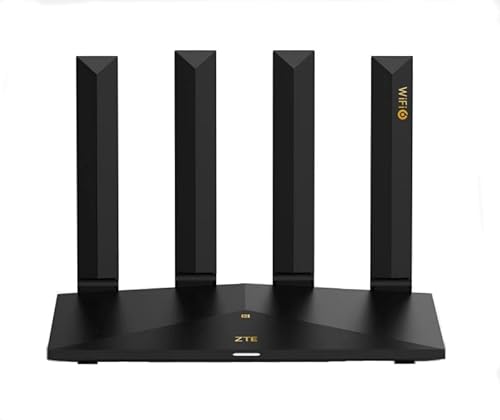

Are ZTE routers good?
ZTE routers have an average overall score of (?), ranking #(?) among all router brands, and a user rating of (?), placing them at #(?) based on user reviews.
ZTE routers are decent for budget-conscious users and deliver reliable performance for basic home networking needs. They provide solid connectivity for small to medium-sized homes, with most models supporting standard Wi-Fi protocols like 802.11ac or 802.11ax (Wi-Fi 6).
ZTE focuses on affordability, so their routers often cost between £30 and £90, depending on features. They include basic security features like WPA3 encryption and firewalls. Setup is straightforward, with user-friendly interfaces for quick configuration.
However, their performance in high-demand scenarios, like heavy gaming or 4K streaming, often lags behind premium brands.
The best ZTE routers are as follows.
- ZTE AX3000 Pro (Overall score: 7.46 points)
What are the main advantages of ZTE routers?
The main advantages of ZTE routers are as follows.
- Wide 5G compatibility: ZTE routers support both Sub-6 GHz and mmWave 5G bands, which gives them strong connectivity across urban and rural areas. In practice, download speeds can reach up to 3.6 Gbps in Sub-6 GHz mode and up to 7 Gbps in mmWave.
- High device capacity: A single ZTE router can handle up to 128 connected devices at the same time. This makes them suitable for homes with many smart devices or for small offices where multiple users rely on stable Wi-Fi.
- Advanced Wi-Fi standards: ZTE integrates Wi-Fi 6 and in some models even Wi-Fi 6E. This improves data throughput up to 9.6 Gbps and reduces latency by around 30% compared to Wi-Fi 5, so it supports high-demand activities like gaming and 4K streaming.
- Strong security features: Routers include WPA3 encryption, VPN pass-through, and built-in firewall functions. This protects connected devices against unauthorized access and improves overall network safety.
- Energy efficiency: ZTE routers use target wake time (TWT) in Wi-Fi 6, which reduces power consumption in connected devices by up to 67%. This extends battery life in smartphones, laptops, and IoT products.
- Flexible deployment: Many ZTE routers support both fixed-line (fiber or DSL) and mobile SIM-based connectivity. This dual-mode setup works as a backup if one connection drops, so users maintain constant internet access.
What are the main disadvantages of ZTE routers?
The main disadvantages of ZTE routers are as follows.
- Limited software updates: Firmware updates are not as frequent as with competitors like Huawei or AVM FRITZ!Box, which reduces long-term security and feature improvements.
- Restricted availability: ZTE routers are not as widely distributed in Europe or North America, so replacement parts and service centers can be harder to access.
- Interface complexity: The web interface is less intuitive compared to brands like Google Nest or eero, which makes configuration more difficult for less experienced users.
- Higher latency in budget models: Entry-level ZTE routers show average latency above 30 ms under heavy load, while competitors in the same price range often stay below 20 ms.
- Limited app ecosystem: ZTE’s mobile management app lacks advanced parental controls and device prioritization functions that competitors include by default.
Who makes ZTE routers?
ZTE routers are made by ZTE Corporation, a Chinese multinational telecommunications company founded in 1985.
The company is headquartered in Shenzhen, China, and operates worldwide as one of the largest telecom equipment and network solutions suppliers. It produces routers for home use, enterprise networks, and telecom operators, and it supplies devices to many internet service providers under their own branding.
ZTE employs more than 70,000 people and operates in over 160 countries. Besides routers, it manufactures smartphones, switches, base stations, and 5G infrastructure equipment. The company is publicly traded on both the Shenzhen and Hong Kong stock exchanges.
How popular are ZTE routers?
ZTE routers are a smaller player worldwide, with shipments in 2024 estimated at about 4 million units and a global market share near 3 %, so the brand stayed outside the global top 5 vendors. ZTE focused heavily on telecom partnerships, supplying 4G/5G and fiber routers to operators rather than selling mainly through retail.
ZTE performed strongest in Asia, where its share reached around 5 %, while in Europe it stayed below 2 % and in North America its presence was minimal.
What are the main ZTE router series?
The main ZTE router series are as follows.
- The main ZTE router series are as follows:
- ZXHN series: Focused on broadband and fiber access, often used by telecom operators. These routers support ADSL, VDSL, and GPON technologies and include models for home gateways with integrated Wi-Fi.
- MF series: Mobile Wi-Fi routers and MiFi devices that use 3G, 4G, and 5G networks. They are compact units with SIM card slots that provide internet access through cellular connections.
- MC series: 5G CPE (Customer Premises Equipment) routers for home and business use. They connect to mobile networks and distribute internet over Wi-Fi 6 and Ethernet, with support for both sub-6 GHz and mmWave bands.
- MF2xx and MF9xx series: Portable mobile hotspots and pocket routers. They are designed for individual use and include battery-powered models for travel.
- ZXHN home gateway sub-series: Specific gateways for operators with IPTV, VoIP, and smart home integration. They include dual-band Wi-Fi and gigabit Ethernet ports for high-speed connections.
How much do ZTE routers cost?
ZTE routers cost between £30 and £170, depending on the model and its specifications.
Entry-level ZTE routers are in the range of 30–£60, which covers basic Wi-Fi models with standard speeds for small households. Mid-range devices usually cost 80–£110, and they support dual-band Wi-Fi, higher speeds, and more stable connections suitable for larger apartments or small offices. High-end ZTE routers can reach 150–£170, as they include advanced features such as Wi-Fi 6, higher throughput, and stronger antennas that improve coverage.
The following chart shows the price distribution of ZTE routers.
[vertical-chart-01251665276967276127121197218523429521752370337239]
What should you consider while choosing the best ZTE router?
When choosing the best ZTE router, you need to consider the following factors:
- Network technology: ZTE routers support different generations of mobile networks, from 4G LTE to 5G capabilities. The latest ZTE 5G models like the G5 and MC801A support both SA (Standalone) and NSA (Non-Standalone) 5G networks with theoretical speeds up to 4.6Gbps. 4G models typically reach speeds of 150-300 Mbps download, while 5G variants achieve multi-gigabit performance. Consider your local network availability and required bandwidth when selecting between 4G and 5G variants.
- WiFi standards: Modern ZTE routers incorporate WiFi 6 (802.11ax) or the latest WiFi 7 technology, which determines wireless device connectivity speed and capacity. The ZTE G5 supports WiFi 7 with speeds up to 3.6Gbps, while models like MC801A and G5B feature WiFi 6 with dual-band operation at 2.4GHz and 5GHz frequencies. WiFi 6 models typically support 32-128 connected devices simultaneously, while newer variants handle even more connections with improved efficiency through OFDMA and MU-MIMO technologies.
- Antenna and coverage: ZTE routers feature different antenna setups that affect signal reception and wireless coverage range. Fixed models like the MC801A include high-gain directional antennas up to 9dBi for better cellular signal reception, plus omnidirectional antennas for WiFi coverage. Some models support external antenna connections for improved signal in weak coverage areas, while others rely on built-in smart antenna algorithms that automatically select the strongest available signal.
- Security features: ZTE routers implement various security standards including WPA2-PSK, WPA3-PSK encryption, and built-in firewall protection with stateful packet inspection. Advanced models include VPN pass-through support for L2TP, PPTP, and IPSec protocols, plus features like MAC filtering, URL filtering, and parental controls. Some enterprise-oriented models feature hardware protection with secure boot capabilities and encrypted firmware storage to prevent unauthorized access.
- Connectivity: Different ZTE series offer varying port combinations depending on intended use cases. Basic models include 1-2 Gigabit Ethernet ports, while advanced routers feature multiple Gigabit LAN ports, 2.5GbE ports for high-speed wired connections, and USB ports for external storage or device sharing. Business-oriented models may include RJ11 VoIP ports for voice services and additional management interfaces.
- Performance: ZTE routers use different chipset platforms that determine overall performance and feature support. Entry-level models use basic processors suitable for standard home use, while advanced 5G routers incorporate Qualcomm Snapdragon platforms like SDX55 or SDX62 that handle high-speed data processing and multiple simultaneous connections. The processor choice affects maximum throughput, concurrent device support, and advanced features like band aggregation and carrier aggregation capabilities.
- Device capacity: ZTE router series differ in maximum supported device connections and intended applications. Portable models like MF927U support up to 32 devices and focus on mobility, while stationary routers like MC801A handle 64+ devices with better performance per connection. Business and home office models support additional services like VoIP calling, DLNA media streaming, and advanced QoS management for bandwidth prioritization across different device types and applications.