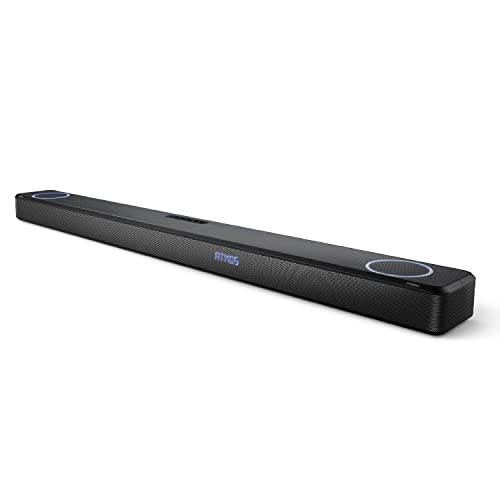
Are Philips soundbars good?
Philips soundbars are good if you are looking at the Fidelio-style premium tier with Dolby Atmos, DTS:X, Wi-Fi, Bluetooth, a wireless subwoofer, rear speakers, and a high-channel layout. This is a much more cinema-focused profile than a basic 2.0 or 2.1 TV-audio bar.
The main strength is hardware completeness. A 7.1.2 layout, 450 W output, two HDMI inputs, 4K pass-through, wireless bass, and rear-speaker support put Philips closer to LG and Samsung's premium package approach than to compact entry brands.
The main limitation is that Philips has less ranked-model depth than brands with several scored soundbars. That means the exact Fidelio model matters more than broad Philips-brand assumptions.
What are the main advantages of Philips soundbars?
The main advantages of Philips soundbars are as follows.
- 7.1.2 layout: The Philips Fidelio profile uses a 7.1.2 channel layout. That is a much stronger home-cinema configuration than basic 2.0, 2.1, or 3.1 soundbars.
- Dolby Atmos: Philips supports Dolby Atmos on Fidelio-style premium models. That gives the soundbar an object-audio path for compatible films, games, and streaming content.
- DTS support: DTS:X is also included. This matters if you use Blu-ray, local media, or other sources where DTS formats are still relevant.
- Wireless subwoofer: The Philips Fidelio setup includes a wireless subwoofer. That gives it a stronger bass foundation than soundbars that rely only on small built-in drivers.
- Rear speakers: Rear speakers and wireless rear compatibility are part of the Philips setup. That gives the system a real surround-hardware advantage over front-bar-only models.
- HDMI inputs: Two HDMI inputs and 4K pass-through make Philips useful as a device-routing soundbar. This is helpful if you want to connect more than only the TV audio return path.
What are the main disadvantages of Philips soundbars?
The main disadvantages of Philips soundbars are as follows.
- High price: The Philips Fidelio tier sits around £800. That places it closer to premium soundbar packages than to budget TV-audio upgrades.
- Narrow coverage: Philips has less ranked-model depth than LG, Samsung, Sony, or JBL. The exact Fidelio model matters more than broad Philips range assumptions.
- Complex setup: A 7.1.2 layout with wireless subwoofer and rear speakers needs more placement planning than a simple one-bar system. It is not the cleanest option for very small rooms.
- Unclear ARC detail: The available spec data does not clearly resolve the ARC/eARC type for the Philips Fidelio model. Check the exact HDMI return-channel specification before buying.
- Not a budget brand: Philips is not the best match if you only need a cheap Bluetooth or ARC soundbar. Majority, Sharp, Hisense, or entry JBL models fit that role more directly.
Who makes Philips soundbars?
Philips soundbars are sold under the Philips brand, which belongs to Koninklijke Philips N.V. for brand ownership. Philips is a Dutch company with long electronics roots, but Philips TV and audio products in many markets are developed and brought to market by TP Vision under license from Koninklijke Philips N.V.
TP Vision says it uses the Philips brand under license and works in consumer TV and audio, including Philips Sound and Philips Fidelio products. That means a Philips soundbar is tied to the Philips brand and design identity, while the current TV/audio product business is closely associated with TP Vision rather than Philips operating as a standalone soundbar-only manufacturer.
What are the main Philips soundbar series?
The main Philips soundbar families are Fidelio and the TAB / numbered Philips soundbar range. Fidelio is the premium home-cinema line, where the stronger specs are most relevant: Dolby Atmos, DTS:X, higher channel counts, wireless bass, rear-speaker support, Wi-Fi, HDMI inputs, and 4K pass-through.
The TAB / numbered Philips soundbar models cover the broader everyday range, including simpler 2.0 and 2.1 TV bars as well as step-up models with subwoofers or stronger HDMI support. When comparing Philips models, first check whether you are looking at a Fidelio premium system or a TAB-style mainstream soundbar.
How much do Philips soundbars cost?
Philips soundbars usually cost about £90-£800, depending on whether you choose a basic TAB-style TV bar or a premium Fidelio surround package.
The lower Philips TAB range is usually the cheaper part of the lineup, covering simpler 2.0 and 2.1 TV-audio models. These are the models to compare if you mainly want clearer TV sound, Bluetooth playback, and a lower price.
The higher Fidelio price is tied to stronger hardware: 7.1.2 channels, Dolby Atmos, DTS:X, about 450 W output, wireless subwoofer, rear speakers, Wi-Fi, Bluetooth, HDMI inputs, and 4K pass-through. Fidelio pricing makes more sense when you want the larger surround system rather than a basic TV speaker upgrade.
How do Philips soundbars compare with LG models?
Philips soundbars usually compare with LG as a premium surround-package option, while LG has the broader model ladder. Philips is strongest when you are looking at a Fidelio-style 7.1.2 system with Atmos, DTS:X, wireless subwoofer, rear speakers, Wi-Fi, and HDMI inputs; LG is stronger if you want more choices across cheap, midrange, and flagship tiers.
The Philips advantage is package completeness at the Fidelio level. A 7.1.2 setup with rear speakers and wireless bass is more ambitious than many one-bar systems.
The LG advantage is range depth. LG covers basic 2.0 and 2.1 soundbars, eARC models, Atmos/DTS:X models, Wi-Fi models, bundled-subwoofer packages, and high-channel setups such as 7.1.4, so it gives buyers more price and feature steps.
What should you consider while choosing the best Philips soundbar?
The main things to check while choosing the best Philips soundbar are as follows.
- Model tier: Start by checking whether the Philips model is a Fidelio-style premium soundbar or a simpler Philips TV-audio bar. The Fidelio profile is much more advanced, with 7.1.2 channels, Atmos, DTS:X, wireless subwoofer, rear speakers, Wi-Fi, and HDMI inputs. Do not compare it directly with cheap 2.0 bars as if they solve the same problem.
- Channel layout: A 7.1.2 system is a strong reason to consider Philips. It gives you front, surround, bass, and height-channel structure rather than basic stereo playback. If the exact model has fewer channels, reassess it separately instead of assuming all Philips bars match the Fidelio profile.
- Bass hardware: Check whether a wireless subwoofer is included. The Fidelio setup includes wireless bass, which is important for films and games. If a cheaper Philips model lacks this, it will not deliver the same low-end foundation.
- Rear speakers: Rear speakers are a major part of the Philips premium value. They matter if you want real surround effects rather than only front-bar processing. Check whether the model includes them in the box or only supports them as an optional expansion.
- HDMI routing: Two HDMI inputs and 4K pass-through make the Fidelio-style Philips model useful for device routing. This matters if you connect a console, streaming box, or disc player through the soundbar. Also verify the exact ARC/eARC support because the available Philips spec data does not resolve that detail clearly.
- Room fit: A full Philips surround package needs more space than a single compact bar. Plan for the main bar, wireless subwoofer, rear speakers, power sockets, and clear seating position. If the room is small or setup simplicity matters most, a one-bar model may be easier.