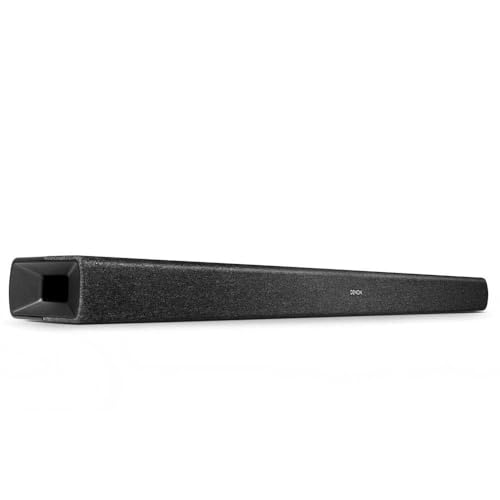
Are Denon soundbars good?
Denon soundbars are generally good if you want a compact audio-brand soundbar rather than a TV-brand package with a separate subwoofer in the box. The key split is between DHT-S216 for a simpler 2.1 ARC setup and Home Sound Bar 550 for eARC, Dolby Atmos, DTS:X, Wi-Fi, and wireless expansion.
The brand is strongest when you value format support and connected audio more than bundled bass hardware. Home Sound Bar 550 gives Denon a more advanced compact model, while DHT-S216 covers the lower-cost HDMI ARC and Bluetooth role.
The main limitation is lineup depth. Denon does not offer many closely spaced soundbar choices here, so buyers who want several channel layouts, bundled subwoofer packages, or very large Atmos systems may find broader options from Sonos, LG, Samsung, or Sony.
What are the main advantages of Denon soundbars?
The main advantages of Denon soundbars are as follows.
- Object audio: Denon Home Sound Bar 550 supports both Dolby Atmos and DTS:X. This gives Denon a stronger object-audio path than basic stereo or virtual-surround-only soundbars.
- eARC support: Home Sound Bar 550 includes eARC for the more advanced TV-audio connection path. The cheaper DHT-S216 stays on HDMI ARC, so the Denon range has a clear connection step-up.
- Wi-Fi audio: Wi-Fi is available on Home Sound Bar 550. That makes it the better Denon choice for connected audio, app control, and Denon's wider home-audio ecosystem.
- HDMI pass-through: Both Denon models include HDMI input and 4K pass-through in the local specs. That is useful if you want to route a TV device through the soundbar instead of using only a basic optical-style connection.
- Compact premium bar: Home Sound Bar 550 is about 650 mm wide while still adding eARC, Atmos, DTS:X, Wi-Fi, and wireless rear compatibility. It gives Denon a compact premium option rather than only a wide living-room bar.
- Bluetooth playback: Bluetooth is present on both Denon models. That keeps quick phone playback available even on the lower DHT-S216.
What are the main disadvantages of Denon soundbars?
The main disadvantages of Denon soundbars are as follows.
- Small lineup: Denon has a narrow soundbar range. You mainly compare DHT-S216 against Home Sound Bar 550 rather than choosing from many close channel and price tiers.
- No bundled subwoofer: Denon does not include a separate subwoofer with these models. DHT-S216 has a 2.1 layout, but it is not the same buying proposition as a package with an external bass module.
- Limited channels: Denon does not offer the same 5.1.2, 7.1.4, or 9.1.4 ladder as some premium soundbar brands. The range is more compact and format-focused than channel-count-heavy.
- Wi-Fi gap: DHT-S216 does not include Wi-Fi. If you want connected streaming and app ecosystem features, you need the Home Sound Bar 550 tier.
- Large price jump: The move from DHT-S216 to Home Sound Bar 550 is a big step. The extra cost mainly buys eARC, Dolby Atmos, DTS:X, Wi-Fi, and wireless expansion rather than a bundled subwoofer.
Who makes Denon soundbars?
Denon soundbars are made under the Denon brand, a Japanese audio name that traces its roots to 1910. Denon is known mainly as a hi-fi and home-theater audio brand rather than a TV manufacturer, with a product history that includes amplifiers, receivers, headphones, wireless speakers, and soundbars.
Denon has also been part of the Sound United audio portfolio alongside brands such as Marantz, Polk, and Definitive Technology. That background matters because Denon soundbars fit into a wider home-audio and home-cinema ecosystem, especially when the model supports Wi-Fi, HEOS-style multiroom audio, or wireless surround expansion.
What are the main Denon soundbar series?
The main Denon soundbar series are as follows.
- DHT-S series: DHT-S models such as DHT-S216 are the simpler TV-soundbar direction. DHT-S216 focuses on 2.1 playback, HDMI ARC, Bluetooth, 4K pass-through, and a wider 890 mm cabinet rather than Wi-Fi, eARC, Dolby Atmos, or wireless rear-speaker expansion.
- Home Sound Bar line: Denon Home Sound Bar 550 is the more connected and format-rich line. It adds eARC, Dolby Atmos, DTS:X, Wi-Fi, Bluetooth, 4K pass-through, and wireless rear-speaker compatibility in a more compact 650 mm cabinet.
- Expansion ecosystem: The Home Sound Bar direction is the one to consider if you want Denon wireless surround expansion later. The DHT-S216 path is better understood as a self-contained TV bar rather than the base of a wider wireless speaker setup.
How much do Denon soundbars cost?
Denon soundbars usually cost about £170-£510, with a clear jump between the simple DHT-S tier and the connected Home Sound Bar tier.
The Denon DHT-S216 sits around £170-£215. That price is tied to a 2.1 layout, HDMI ARC, Bluetooth, one HDMI input, 4K pass-through, and 120 W output rather than to Wi-Fi or advanced object-based formats.
Denon Home Sound Bar 550 sits around £470-£510. The higher price buys eARC, Dolby Atmos, DTS:X, Wi-Fi, Bluetooth, 4K pass-through, and wireless rear-speaker compatibility in a smaller cabinet.
How do Denon soundbars compare with Sonos models?
Denon soundbars usually compare with Sonos as the smaller and more traditional HDMI-focused brand, while Sonos has the broader Wi-Fi ecosystem and stronger premium channel ladder. Denon is easier to read if you are choosing between one basic ARC bar and one connected Atmos/DTS:X bar; Sonos gives you Ray, Beam Gen 2, Arc, and Arc Ultra as a wider step-up path.
Denon has one advantage for buyers who want HDMI input and 4K pass-through on the soundbar itself. Sonos focuses more on TV eARC/ARC and Wi-Fi ecosystem behavior, and its products are stronger when you want app control, multiroom audio, and wireless expansion across a full Sonos household.
At the premium end, Sonos stretches further. Arc and Arc Ultra move into larger 5.0.2 and 9.1.4 layouts, while Denon's compact Home Sound Bar 550 focuses on eARC, Atmos, DTS:X, Wi-Fi, and expansion without becoming a large multi-driver flagship bar.
What should you consider while choosing the best Denon soundbar?
The main things to check while choosing the best Denon soundbar are as follows.
- Model tier: Start by deciding between DHT-S216 and Home Sound Bar 550. DHT-S216 is the simpler ARC, Bluetooth, and 2.1 TV-upgrade model, while Home Sound Bar 550 is the eARC, Atmos, DTS:X, Wi-Fi, and expansion model. This is the most important Denon decision because the lineup is small and the two models serve different roles.
- HDMI level: Check ARC versus eARC before comparing smaller features. DHT-S216 uses ARC, while Home Sound Bar 550 uses eARC for the more advanced TV-audio path. If your TV and content setup need higher-bandwidth audio handling, the Home Sound Bar tier is the safer match.
- Format support: Dolby Atmos and DTS:X belong to Home Sound Bar 550 in this Denon range. DHT-S216 stays outside that format tier and should be treated as a simpler 2.1 soundbar. If you mainly watch broadcast TV or casual streaming, that may be enough; if film audio matters more, the format support changes the decision.
- Wi-Fi features: Wi-Fi is another clear divider between the two Denon models. Choose the Home Sound Bar line if multiroom-style audio, app control, or connected speaker expansion matters. Choose DHT-S216 only if HDMI ARC and Bluetooth cover the use case.
- Bass setup: Do not assume Denon includes a separate subwoofer. DHT-S216 uses a 2.1 approach, but the listed Denon models do not bundle an external bass box. If deep low-end impact is important, compare the internal bass design and expansion options before buying.
- Cabinet size: DHT-S216 is the wider 890 mm model, while Home Sound Bar 550 is about 650 mm wide. The smaller model is not the cheaper one; it is the more advanced compact connected bar. Compare width against the TV stand and also check whether you need the advanced features enough to justify the smaller premium model.