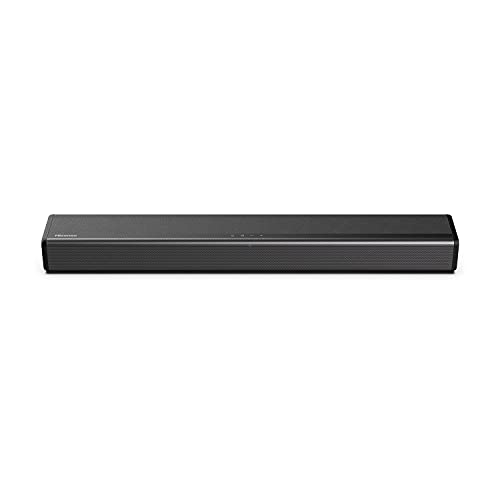
Are Hisense soundbars good?
Hisense soundbars are generally good if you want a low-cost, compact 2.1 TV-audio upgrade with HDMI ARC, Bluetooth, and built-in bass. The HS214-style direction is more useful for simple TV sound and casual music playback than for advanced surround formats.
The main strength is the all-in-one 2.1 setup: the subwoofer is built into the bar, so you get a bass-focused design without placing a separate subwoofer box. The trade-off is that Hisense has less soundbar model depth than Samsung, Sony, or JBL.
That makes Hisense a better fit for buyers comparing simple budget bars than for buyers looking for eARC, Dolby Atmos, Wi-Fi streaming, wireless rear-speaker expansion, or several closely spaced model tiers.
What are the main advantages of Hisense soundbars?
The main advantages of Hisense soundbars are as follows.
- Low price: Hisense sits around the budget soundbar tier. That makes the brand easier to consider for a low-cost TV-audio upgrade.
- 2.1 layout: HS214-style Hisense soundbars use a 2.1 configuration. That gives them a bass channel instead of staying at a plain 2.0 stereo layout.
- Built-in subwoofer: The subwoofer is built into the bar on this Hisense setup. This keeps the system compact and avoids a separate bass box.
- HDMI ARC: HDMI ARC gives Hisense a practical TV connection for everyday use. It is the key port for one-cable TV audio and basic remote-control convenience.
- Compact cabinet: A 650 mm width is easy to place under smaller TVs and on narrow furniture. That makes Hisense practical for bedrooms, secondary rooms, and compact TV setups.
- Bluetooth playback: Bluetooth is included for quick wireless playback from a phone, tablet, or laptop. It adds casual music use without requiring a Wi-Fi speaker ecosystem.
What are the main disadvantages of Hisense soundbars?
The main disadvantages of Hisense soundbars are as follows.
- Narrow lineup: Hisense has less soundbar model depth than brands such as Samsung, Sony, or JBL. That leaves fewer close alternatives inside the same brand.
- No Dolby Atmos: The HS214-style Hisense setup does not include Dolby Atmos. It should be treated as a simple 2.1 TV-audio upgrade, not as an immersive-format soundbar.
- No Wi-Fi: Wi-Fi is not part of the basic Hisense setup. If you want app-connected streaming, multiroom audio, AirPlay, or Chromecast, check another model or brand.
- No rear expansion: Rear speakers and wireless rear-speaker compatibility are not part of the HS214-style setup. That limits the surround upgrade path.
- Basic HDMI: HDMI ARC is useful, but the setup does not move into eARC or meaningful HDMI pass-through. That makes it less suitable as an advanced TV-and-device connection hub.
Who makes Hisense soundbars?
Hisense soundbars are made under the Hisense brand, which belongs to Hisense, a Chinese electronics and appliance company established in Qingdao in 1969. Hisense describes itself as a privately owned company with more than 100,000 employees, four industry divisions, several global and regional brands, and production and R&D sites across multiple continents.
The company is broader than audio: its identity is tied mainly to TVs, appliances, displays, and consumer electronics rather than to soundbars alone. That means a Hisense soundbar fits into a TV-and-home-electronics ecosystem, especially as a practical companion product for Hisense TVs, rather than coming from a specialist hi-fi soundbar brand.
What are the main Hisense soundbar series?
The main Hisense soundbar series to understand are as follows.
- HS all-in-one line: HS models such as HS214 are the simple TV-audio direction, with a compact cabinet, HDMI ARC, Bluetooth, and a built-in subwoofer. This is the Hisense path to compare if you want a lower-cost 2.1 upgrade without placing a separate bass module.
- 2.1 budget tier: The most relevant Hisense configuration is 2.1 rather than 2.0. It gives you a dedicated bass channel inside the bar, but it does not add rear speakers, Wi-Fi, or Atmos-style height processing.
- TV-companion role: Hisense positions the HS214-style bar as an easy companion for TV use, including ARC control and Roku TV Ready-style setup on compatible models. That makes the series more about simple TV integration than about building a larger modular surround system.
How much do Hisense soundbars cost?
Hisense soundbars usually cost around the entry-level soundbar tier, with HS214-style models sitting around £90.
That price is consistent with the hardware: 2.1 channels, HDMI ARC, Bluetooth, a built-in subwoofer, and a compact 650 mm cabinet. It does not price in eARC, Dolby Atmos, Wi-Fi, rear-speaker expansion, or a separate subwoofer package.
So Hisense is best understood as a budget TV-audio brand for this type of soundbar. If you want a bigger cinema setup, the cost comparison should move to brands and models with higher channel counts, Atmos support, or bundled bass/rear hardware.
How do Hisense soundbars compare with Samsung models?
Hisense soundbars usually compare with Samsung as the simpler and cheaper 2.1 option, while Samsung has the broader model ladder. Hisense is easier to understand if you want one compact ARC-and-Bluetooth bar with built-in bass, while Samsung gives you more choices across 2.0, 2.1, 3.0, 3.1, 5.0, and 5.1.2 layouts.
The Samsung advantage is depth. Samsung offers models with eARC, Dolby Atmos, Wi-Fi, bundled subwoofers on selected B/Q models, and Q-Symphony, which lets compatible Samsung TVs and Samsung soundbars play through TV and soundbar speakers together.
The Hisense advantage is simplicity. A HS214-style 2.1 all-in-one bar is easier to place and cheaper to buy, but it should not be treated as a direct substitute for Samsung's Q-series or S-series step-up models if you need Atmos, Wi-Fi, or stronger expansion options.
What should you consider while choosing the best Hisense soundbar?
The main things to check while choosing the best Hisense soundbar are as follows.
- Channel layout: Confirm whether the model is a 2.1 all-in-one bar or a simpler 2.0 design. A 2.1 layout gives you a bass channel, but on HS214-style models that bass is built into the bar rather than handled by a separate subwoofer. If you expect a separate bass box, check the product photos and subwoofer type before buying.
- TV connection: HDMI ARC is the key connection to prioritize for Hisense TV use. It is better for everyday TV sound than relying on Bluetooth because it supports a stable TV audio path and easier remote-control behavior. Do not assume eARC unless the exact model lists it clearly.
- Bass design: Built-in subwoofer hardware is useful when space is limited, but it is not the same as a separate wireless subwoofer. Choose the built-in approach if you want fewer boxes and simpler placement. Choose a different Hisense model or another brand if deeper bass output is more important than compact setup.
- Smart features: Check Wi-Fi, app control, AirPlay, Chromecast, and multiroom support explicitly. The HS214-style Hisense setup is Bluetooth-based for wireless music, not a full Wi-Fi streaming platform. If connected-audio features matter, this is one of the first specs to verify.
- Expansion path: Look for rear-speaker support and subwoofer pairing only if you plan to expand later. The basic Hisense all-in-one path does not give you the same rear-channel upgrade route as more modular soundbar systems. If you want surround expansion, do not buy only on the Hisense brand name; check the exact model's compatibility list.
- Size fit: A roughly 650 mm soundbar is a compact match for smaller TVs and narrower furniture. It can look undersized under very large TVs, but it is practical for bedrooms, secondary rooms, and simple living-room setups. Compare cabinet width and height with the TV feet, screen width, and shelf clearance before choosing.