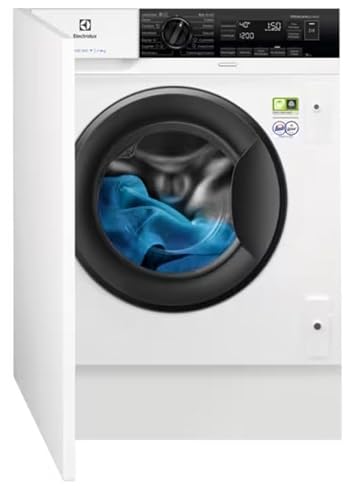
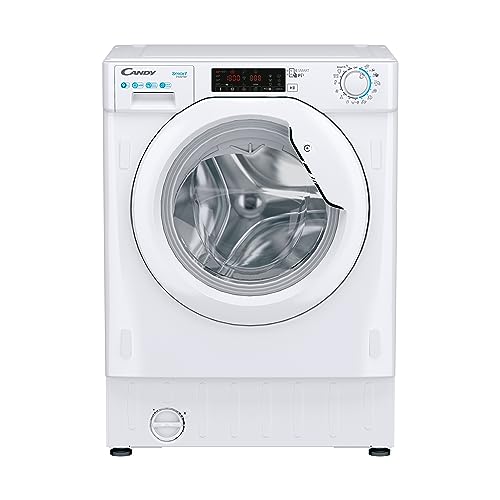
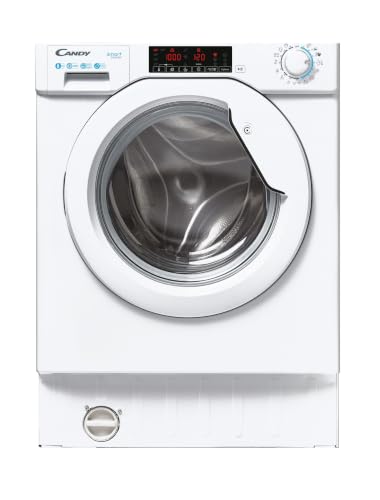
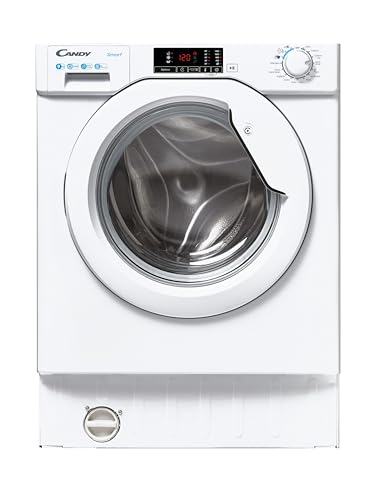
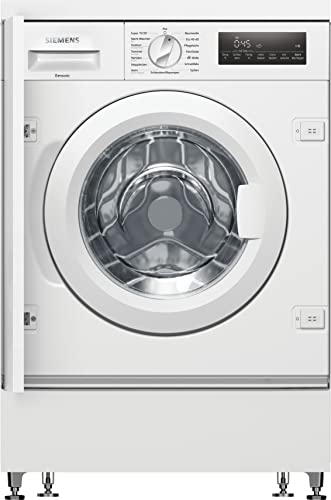
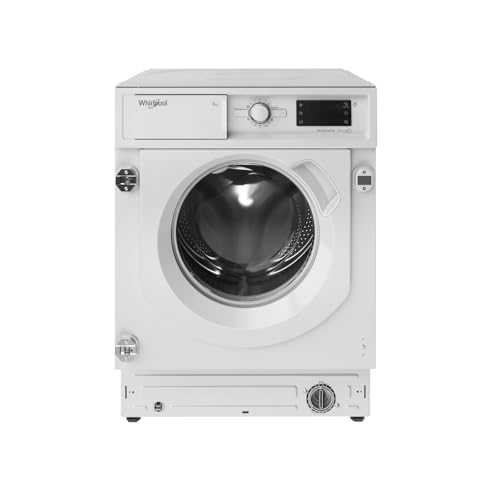
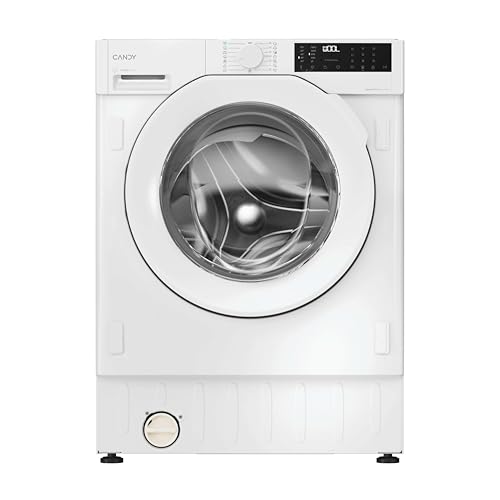
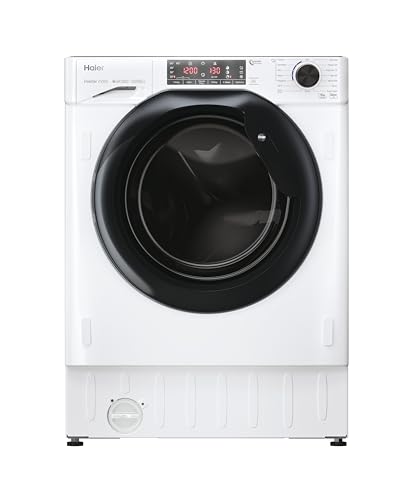
When choosing the best built-in washing machine, consider its capacity and drum volume, dimensions, energy consumption, water use, spin-drying efficiency, noisiness, motor type, and available washing programs.
What is the capacity of built-in washing machines?
Built-in washing machines have a capacity ranging from 7 to 9 kg, with 8 kg being the most common (57%). They usually have a drum volume between 50 to 60 liters, with an average of 58 liters.
Built-in washing machines take up between 0.26 and 0.28 m³ of space, with an average of around 0.264 m³ (slightly less than freestanding washing machines, which average around 0.28 m³). Built-in washing machines are between 53 and 56 cm deep, so there are no slim models.
The following chart illustrates how capacities are spread across built-in washing machines.
[pie-chart-11413210705214202]
How energy-efficient are built-in washing machines?
Built-in washing machines are generally less energy-efficient compared to freestanding models. The energy classes for built-in washing machines range from A to D, with C class being the most common (38% share). In contrast, the most common energy class for freestanding washing machines is A (39% share).
Built-in washing machines consume between 45 to 75 kWh per 100 cycles, with an average of 62 kWh. This is about 7 kWh more than the average freestanding washing machine, which uses about 55 kWh per 100 cycles. Energy consumption correlates with energy classes. For example, A class washing machines usually use under 49 kWh per 100 cycles, while B class washing machines use under 55 kWh. However, this correlation can vary slightly with the machine’s capacity.
Built-in washing machines use between 40 to 50 liters per cycle, with an average consumption of 44 liters.
The energy class distribution of built-in washing machines is displayed in the following chart.
[pie-chart-23964923505720248]
What is the spin-drying efficiency class of built-in washing machines?
All built-in washing machines analyzed belong to spin-drying efficiency class B. This is similar to freestanding washing machines, where 85% are also in class B. Spin-drying efficiency class measures how well the machine removes water after the final Spin cycle, which affects drying time and energy use.
Spin-drying efficiency class correlates with the maximum spin speed. Most built-in washing machines reach a maximum spin speed of 1400 RPM, with some exceptions at 1200 RPM. Higher spin speeds remove more water, so if you dry your clothes in a dryer, a higher speed can save energy.
If you wash delicate clothes frequently, check the minimum spin speed. A lower spin speed is better for delicate fabrics to avoid damage. The minimum speed for most built-in washing machines ranges from 400 to 800 RPM, with 64% able to reach the lowest speed of 400 RPM.
Are built-in washing machines loud?
Built-in washing machines are generally quieter than freestanding ones. Spin noise levels in built-in washing machines range from 65 dB to 80 dB and on average, they are about 4 dB quieter during the Spin cycle (71 dB vs. 75 dB). Spin noise level is the loudest part of the washing process, which makes it the key measure of noisiness.
Most built-in washing machines fall into noise class A (64%), with the remainder in classes B or C. Class A corresponds to spin noise levels below 73 dB, class B is 73-76 dB, class C is 77-80 dB and class D is above 80 dB.
Built-in washing machines produce between 51 dB and 56 dB of noise during the wash cycle. On average, they are around 6 dB quieter than freestanding washing machines (47 dB vs. 53 dB).
How many washing programs do built-in washing machines have?
Built-in washing machines usually have 14 to 16 washing programs, along with 1 to 2 fast cycles that take less than an hour. They include the basic programs like Cotton, Eco 40-60, Synthetics, Fast Cycle, Mix, Wool, and Pre-wash. They do not differ much from freestanding models.
Built-in washing machines differ in terms of the special programs included, such as stain removal (79% of built-in models), Jeans Cycle (57%), Duvet Cycle (57%), hygiene cycle (50%), baby care cycle (7%), outdoor cycle (64%), allergen cycle (36%) or shirt cycle (50%).
In addition, 57% of built-in models have an anti-crease function, 43% have a rinse-hold function, 93% have an extra-rinse function and 50% have an extra-fast function.
If you need specific cycles or functions, check the programmes available on the model you are considering.
What are some common features of built-in washing machines?
Built-in washing machines usually come with 6 to 11 features, with an average of about 8 features (2 less than the average of freestanding washing machines).
Some features are more common in built-in washing machines than in freestanding models, such as water stop technology (86% vs 62%) and load balancing systems (found in all built-in models vs 77% in freestanding). 64% of built-in washing machines include also an inverter motor, a similar proportion to freestanding washing machines. However, certain features appear less often in built-in washing machines.
The following features are less common in built-in washing machines than in freestanding models:
- Laundry detection system (79% vs 90%): Automatically adjusts the cycle based on the load size for optimal cleaning.
- Steam technology (29% vs 57%): Uses steam to remove stains and wrinkles more effectively.
- Pre-mix technology (14% vs 24%): Mixes detergent and water before it reaches the drum for better washing performance.
- Automatic dosing system (not found in any built-in vs 10% of freestanding models): Automatically measures the correct amount of detergent for each load.
- Automatic drawer cleaning (not found in any built-in vs 12% of freestanding models): Cleans detergent drawers after each use to prevent residue buildup.
- Self-cleaning (43% vs 66%): Automatically cleans the drum to prevent mold and odors.
- Wi-Fi (14% vs 23%): Connects to your smartphone for remote control and monitoring.
- AI (not found in any built-in vs 11% of freestanding models): Uses artificial intelligence to optimize washing cycles based on your preferences and laundry habits.
Are there built-in top-loading washing machines?
There are no built-in top-loading washing machines due to their design. Top-loading models require access from above (which isn't possible with built-in units).